 how-to
How to Get Rid of Hard Water in Your House: A Practical Guide
Table of Contents
- How to Get Rid of Hard Water in a House: Start With the Source
- How to Test Water Hardness at Home
- How to Remove Hard Water Stains From Fixtures and Surfaces
- Water Softener Sizing for Household Water Usage
- Choosing a Whole-House Treatment System That Fits Your Home
- Water Softener Maintenance That Keeps Hard Water Away
- Frequently Asked Questions
Last Updated: October 21, 2026
How to Get Rid of Hard Water in a House: Start With the Source
Hard water is water carrying dissolved calcium and magnesium picked up as it moves through rock and soil. You cannot get rid of hard water in a house by scrubbing alone, because the minerals arrive with every litre that enters your pipes.
At Pure Life H2O, we have spent more than 26 years testing and treating water for homeowners across the Greater Toronto Area, and the same pattern shows up again and again. People fight the symptoms for years before anyone tests the supply.
Here is the distinction most guides skip. Removing limescale from a showerhead is cleaning. Removing the calcium and magnesium that create limescale is treatment. You need both, in that order.
- Cleaning restores what the minerals have already coated.
- Treatment stops new deposits from forming.
- Testing tells you which one matters more in your home.
Municipal supply across the region is generally hard, and private wells can be harder still. Ontario's provincial water quality guidance sets out what is monitored in municipal systems, but hardness itself is not a health concern. It is a comfort and equipment issue.
How to Test Water Hardness at Home
Testing takes about five minutes and tells you exactly how hard your water is. You have two good options: a test strip you dip and read, or a laboratory analysis that gives precise numbers.
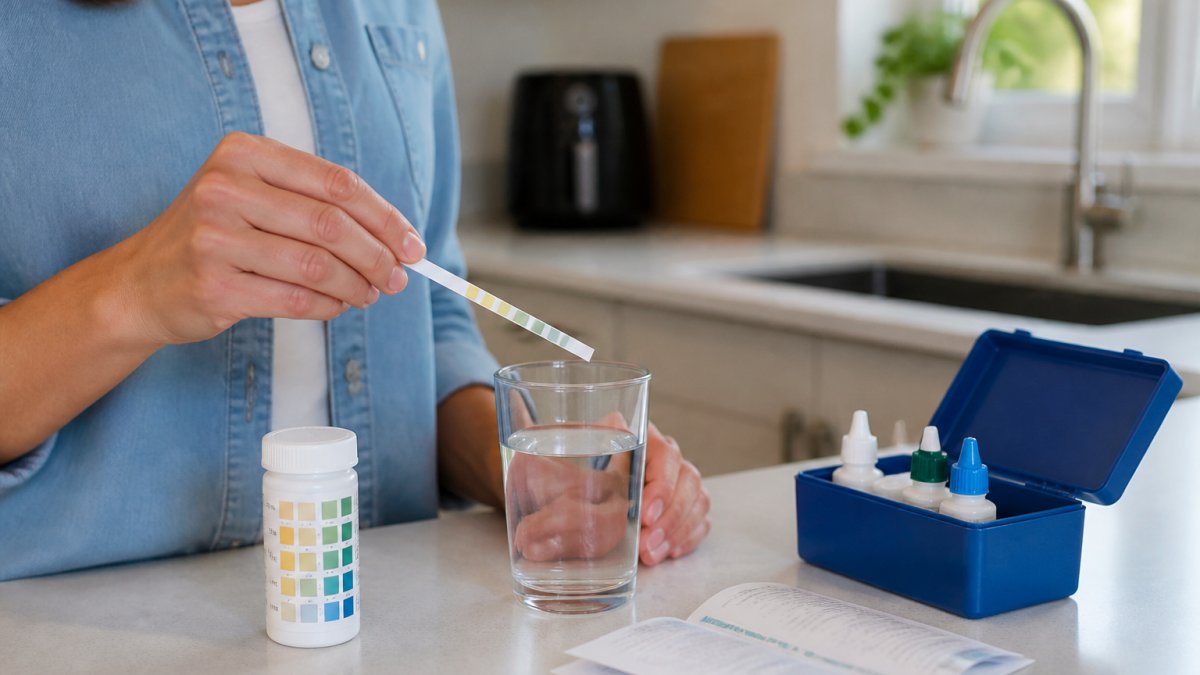
Test strips are fast and cheap. Dip the strip in a glass of cold tap water, wait for the colour to develop, and compare it to the chart on the package.
Lab testing is more accurate and worth it if you have a private well, because it also screens for iron, manganese, sulphur and bacteria. Those change which treatment you need.
Hardness is reported in either grains per gallon (gpg) or milligrams per litre (mg/L) as calcium carbonate. One grain per gallon equals roughly 17.1 mg/L.
Follow these steps for a reliable strip reading:
- Run the cold tap for two minutes to clear standing water from the pipes.
- Fill a clean glass and let it sit for a moment.
- Dip the strip and swirl it for the time stated on the package.
- Shake off excess water and read the colour against the chart.
- Test again a week later to confirm the result.
If you are on a well, test in spring and fall. Snowmelt and heavy rain can shift the numbers.
How to Remove Hard Water Stains From Fixtures and Surfaces
Hard water stains are mineral deposits, and acid dissolves them. That is the whole principle. Vinegar, citric acid and dedicated descalers all work because they are mildly acidic.
White vinegar is the workhorse. Soak a cloth, wrap it around a faucet or showerhead, and leave it for 30 to 60 minutes. For heavier limescale, leave it longer or use cleaning vinegar, which is stronger than the kitchen variety.
- Showerheads: unscrew and soak in a bowl of vinegar for an hour, then scrub the nozzles with an old toothbrush.
- Faucets: wrap with a vinegar-soaked cloth and secure with a bag or elastic band.
- Glass shower doors: wipe with a vinegar solution, then squeegee after every shower to slow the return.
- Kettles and coffee makers: run a citric acid or vinegar cycle, then rinse twice.
- Toilets: pour vinegar around the water line and leave it overnight before scrubbing.
Match the cleaner to the surface. Vinegar is safe on glass, ceramic, chrome and stainless steel. Avoid it on natural stone such as marble or travertine, because acid etches the surface. Use a pH-neutral stone cleaner there instead, and seal the stone.
Never mix vinegar with bleach. The combination releases a harmful gas (Reduce your risk from toxic gases: Never mix bleach with other cleaning products).
Water Softener Sizing for Household Water Usage
A softener that is too small will run out of capacity between regenerations. One that is too large wastes salt and can struggle to regenerate properly. Sizing comes down to two numbers: your water hardness and how much water your household uses. Get both right and the unit will keep up without over-salting.
Hardness you now have from testing. Water use you can estimate from the number of people in the home and typical daily consumption. A softener's capacity is measured in grains of hardness it can remove before regeneration, and it is rated against a specific salt dose.
The sizing formula most installers use
The working number is daily hardness load, measured in grains per day. Multiply your hardness in grains per gallon by your household's daily water use in gallons.
- At 10 gpg and 300 gallons a day, the load is about 3,000 grains per day.
- At 20 gpg and the same use, it is about 6,000 grains per day.
From there, decide how often you want the unit to regenerate. A softener that regenerates every three days needs three times the daily load in usable capacity.
Use this as a working guide:
| Household Size | Typical Daily Use | Hardness Level | Capacity to Look For |
|---|---|---|---|
| 1-2 people | Lower | Moderate | Smaller unit, lower salt use |
| 3-4 people | Average | Hard | Mid-size unit |
| 4-5 people | Above average | Very hard | Larger unit |
| 5+ people or heavy use | High | Very hard | Largest unit, higher regeneration frequency |
Add capacity if your home has a large soaker tub, a hot tub, or high-flow fixtures. Add more if the water is very hard, because each litre carries more minerals to remove.
A common mistake is buying on tank size alone. Two units with the same tank can hold different amounts of resin, and resin volume is what determines capacity. Ask for the resin volume and the rated capacity at a stated salt dose, not just the tank dimensions.
We size every system from a test result rather than a guess. Health Canada's drinking water guidance is a useful reference for understanding what the numbers on your report mean.
Choosing a Whole-House Treatment System That Fits Your Home
No single system does everything, and that is where most buyers get confused. Match the technology to the problem your test revealed.
| What your test shows | What actually solves it | What does not |
|---|---|---|
| Hardness only | Salt-based softener | Salt-free conditioner alone |
| Hardness plus chlorine taste | Softener plus whole-home carbon filtration | Softener alone |
| Iron, manganese, sulphur | Pre-treatment before the softener, sized to the test | Softener alone |
| Bacteria or viruses (well water) | UV disinfection after filtration | Softener or carbon alone |
| Better drinking water at one tap | Reverse osmosis | Whole-home softener |
Salt-based water softeners remove calcium and magnesium through ion exchange. Resin beads capture the minerals and release sodium in their place, then recharge with a brine solution.
Salt-free conditioners change how minerals behave rather than removing them. They can reduce scale sticking to surfaces, but the calcium and magnesium stay in the water.
Reverse osmosis treats drinking water at a single tap. It removes a very wide range of dissolved solids, which makes it excellent for taste and cooking.
Whole-home carbon filtration targets chlorine, chloramine, taste and odour. It does nothing for hardness. Many homes pair carbon filtration with a softener, because the two solve different problems.
UV disinfection makes water microbiologically safe by neutralizing bacteria and viruses. It is a well water treatment, not a hardness treatment, and it needs clear water upstream to work well, which is why filtration usually comes first.
Installation and maintenance context
Whole-home systems are installed on the main line after the meter or pressure tank, so they treat every fixture. Point-of-use systems such as reverse osmosis sit under the kitchen sink. Plan for a drain or discharge point for softeners and reverse osmosis, and a power outlet for UV and some controllers. Maintenance varies by technology: softeners need salt and periodic brine-tank cleaning, carbon cartridges and reverse osmosis membranes need scheduled replacement, and UV lamps need annual replacement to keep disinfecting.
- Hardness only: softener.
- Hardness plus chlorine taste: softener plus carbon filtration.
- Well water with iron, sulphur or bacteria: test first, then build a combination system.
- Better drinking water only: reverse osmosis at the kitchen tap.
We install Pentair systems because the range lets us build that combination properly rather than forcing one unit to do everything. Start with a free water test and the choice becomes much clearer.
Water Softener Maintenance That Keeps Hard Water Away
A softener only keeps hard water away while it is working. Maintenance is simple, but skipping it is the most common reason people end up with scale again.
Check the salt level every four to six weeks. Keep the brine tank at least half full and break up any crust that forms. Salt bridges, where a hard crust forms above a hollow space, stop regeneration without any obvious warning.
Use the right salt. Pellets are cleaner and easier to handle. Crystal salt dissolves faster. Avoid rock salt, which leaves more residue.
Clean the brine tank once a year. Empty it, scrub out the sediment, and refill. Sediment buildup reduces how well the unit recharges.
Watch for these warning signs:
- Water feels less slippery than it used to
- New spots appear on glassware
- The unit runs through salt faster than normal
- You hear the regeneration cycle running at odd times
Replace filters on schedule. Carbon cartridges and reverse osmosis membranes have service lives, and a clogged filter upstream can make the whole system underperform.
If your system is more than a few years old and the water quality has slipped, a service call is cheaper than replacing fixtures. Our team handles maintenance and filter replacement across the region.
Frequently Asked Questions
What are the signs of hard water in a home?
Common signs include white chalky spots on glassware and shower doors, a film on faucets and showerheads, soap that lathers poorly, and stiff laundry. You may also notice scale buildup inside kettles and around drains. These clues point to dissolved calcium and magnesium, but a water test confirms the hardness level in grains per gallon or milligrams per liter before you choose a treatment system.
Will a water softener remove existing hard water buildup?
A softener treats the water at its source so new scale stops forming, but it does not dissolve deposits already stuck to fixtures, showerheads, or heating elements. Remove existing limescale with an acidic cleaner such as vinegar or citric acid, then let the softener prevent it from returning. For heavy scale inside a water heater or tankless unit, a qualified technician may need to descale it.
How do I test water hardness at home?
Start with test strips from a hardware store: dip, wait, and compare the color to the chart, which usually reads in grains per gallon or milligrams per liter. Strips give a rough range. For a precise number before buying a softener, ask for a lab test or a professional water test, which also checks iron, chlorine, and other factors that affect sizing and system choice.
How much maintenance does a water softener need?
Plan to check and top up the salt every few weeks, clean or replace the brine tank as needed, and have the system serviced periodically. Modern softeners regenerate automatically, but salt bridges and hard water bypass can quietly reduce performance. A yearly professional check keeps the resin, valves, and settings working, and it is the best way to avoid the leaks and failures that plague neglected units.
Hard water will keep coating your fixtures for as long as the minerals keep arriving. Cleaning buys you time, but treatment solves the problem. Pure Life H2O has helped more than 4,000 homeowners across the Greater Toronto Area get to the root cause with proper testing, correctly sized Pentair equipment, and ongoing service. Book your free water test and consultation, and we will tell you exactly what your water needs.