 how-to
Signs of Hard Water in Your Home: A 2026 Guide
Table of Contents
- What Hard Water Is and Why It Matters
- Visible White and Chalky Mineral Deposits on Faucets and Fixtures
- Hard Water Stains on Faucets and Shower Doors
- Limescale Buildup in Pipes and Appliances
- Soap Scum, Spots on Dishes, and Poor Lather
- Hard Water Effects on Skin and Hair
- How to Test Water Hardness at Home
- Distinguishing Hard Water From Other Issues
- Frequently Asked Questions
Last Updated: October 16, 2026
What Hard Water Is and Why It Matters
Hard water contains high levels of dissolved minerals, primarily calcium and magnesium. These minerals don't make water unsafe to drink, but they cause visible, frustrating problems around your home.
As water passes through soil and rock, it picks up these minerals, the more present, the "harder" your water. Hard water affects everything from your skin to your appliances, so recognizing the signs of hard water early helps you address the problem before it worsens.
At Pure Life H2O, we've spent over 26 years helping homeowners identify hard water issues and choose the right treatment. Once you know what to look for, the signs of hard water are unmistakable. Below are the most common indicators your home has hard water, and what to do about it.
Visible White and Chalky Mineral Deposits on Faucets and Fixtures
The easiest sign to spot is white, chalky buildup on your faucets, showerheads, and fixtures. This crusty residue is limescale, a combination of calcium and magnesium minerals left behind as water evaporates.
Run your finger across a faucet aerator (the screen at the tip). A rough, chalky texture is limescale. The same buildup appears around faucet bases and on shower fixtures.
This mineral deposit:
- Clogs showerhead holes, reducing water flow
- Makes fixtures look dull and stained
- Hardens over time and becomes difficult to remove
- Signals that mineral buildup is happening inside your pipes too
Many homeowners scrub these deposits away with vinegar or commercial cleaners, only to see them return within weeks, you're treating the symptom, not the cause, since minerals keep flowing through your water supply. Persistent mineral buildup often signals that your plumbing system is aging, and ignoring these recurring stains can eventually lead to the hidden dangers of corroded home pipes.
Hard Water Stains on Faucets and Shower Doors
Hard water leaves stubborn stains regular cleaning won't fully remove: cloudy white streaks on shower doors, and dull spots on chrome faucets that catch the light differently than clean metal.
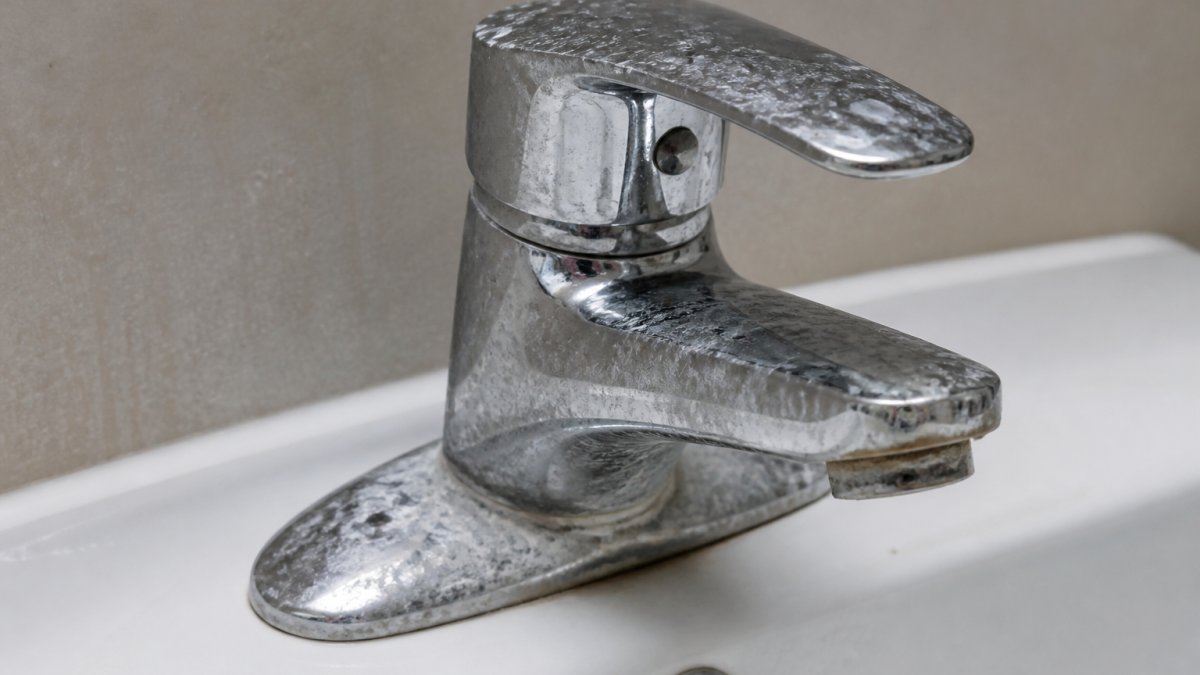
These stains form because minerals don't dissolve completely. As droplets dry, minerals stay behind, and layers build up and bond to the surface over time.
The frustration with hard water stains:
- They're unsightly and make your bathroom look neglected
- Vinegar removes some, but not all of the buildup
- Commercial stain removers often work temporarily
- The stains return within days or weeks
Glass shower doors are especially prone to this, accumulating stains so visibly that many homeowners replace doors or use heavy-duty chemicals regularly.
Limescale Buildup in Pipes and Appliances
What you see on faucets is only part of the problem. Inside your pipes, scale buildup narrows the passages water flows through, reducing water pressure throughout your home.
Over time, scale accumulation:
- Clogs showerheads and aerators completely
- Reduces flow to your washing machine and dishwasher
- Builds up in water heaters, forcing them to work harder
- Shortens the lifespan of appliances by 5-10 years
- Increases energy bills as appliances strain against mineral blockages
Your water heater is especially vulnerable: scale coating the heating element forces it to consume more energy, and a heavily scaled heater can lose 15-20% efficiency.
Soap Scum, Spots on Dishes, and Poor Lather
Hard water prevents soap and detergent from working properly by interfering with how they dissolve and spread across surfaces.
You'll notice:
- Soap doesn't lather well in the shower or bath
- A sticky, soapy residue stays on your skin and hair after washing
- Dishes come out of the dishwasher spotted and cloudy
- Glasses have a white film that won't come off with regular washing
- Laundry detergent doesn't clean effectively, leaving clothes dingy
White spots on dishes form when hard water minerals dry on the surface. Rinse aids help but don't solve the root problem, so many homeowners run the dishwasher twice or use extra detergent.
Soap scum builds up in bathtubs and showers as soap combines with hard water minerals, creating a sticky, grimy layer that's hard to scrub away and gives mold and mildew a surface to grow on.
Hard Water Effects on Skin and Hair
Hard water doesn't just affect your fixtures, it affects you. Many people with hard water report:
- Dry, tight, or itchy skin after bathing
- Skin irritation or flare-ups for people with eczema or psoriasis
- Dull, brittle, or difficult-to-manage hair
- Hair that feels sticky or weighed down even after washing
- Scalp irritation or dandruff that improves when traveling
The reason is simple: hard water minerals coat skin and hair, trapping moisture and preventing soap from rinsing completely, leaving a residue that dries out skin and worsens hair.
People with sensitive skin or scalp conditions often find symptoms worsen with hard water; switching to softer water frequently improves skin and hair noticeably.
How to Test Water Hardness at Home
Testing your water is the only way to move from guessing to knowing. Three practical options each answer a different question.
Option 1: Test strips (fastest, least precise)
Test strips give you a rough hardness range in about a minute. They're sold at hardware stores and home centers.
- Fill a clean glass with cold tap water. Let it run for a few seconds first so you're not sampling water that's been sitting in the pipe.
- Dip the strip for the time printed on the package, usually 1-3 seconds.
- Shake off excess water and wait for the color to develop, typically 30-60 seconds.
- Match the pad color to the chart on the package.
Strips report hardness in one of two units. In Canada, most water utilities report milligrams per litre (mg/L), which is the same as parts per million (ppm).
Option 2: A titration test kit (more precise, still DIY)
A drop-count titration kit costs more than strips but gives a sharper number: add drops of reagent to a measured sample until the color changes, then count drops.
Option 3: A laboratory test (most complete)
A lab test is the right call when you need more than a hardness number. If you'd like a professional assessment, get your free water test to understand exactly what's in your water and what treatment options suit your home.
Municipal customers often don't need a lab test at all.
Reading your result
Hardness is usually expressed as calcium carbonate equivalent. Common bands are:
- Soft: 0-60 mg/L (0-3.5 gpg)
- Moderately hard: 61-120 mg/L (3.6-7 gpg)
- Hard: 121-180 mg/L (7.1-10.5 gpg)
- Very hard: over 180 mg/L (over 10.5 gpg)
These bands are conventions, not regulatory limits.
If your result lands in the hard or very hard band and you see scale or soap problems, that's your signal to look at treatment. If it lands in the soft or moderately hard band but symptoms persist, the cause is probably something other than hardness, covered next.
Distinguishing Hard Water From Other Issues
Not every household problem is caused by hard water, and some symptoms blamed on hardness have a different source.
What hard water does and does not mean for health
Calcium and magnesium are minerals, not contaminants.
Hardness affects aesthetics and household performance: taste, scale, soap lather, and appliance wear.
Symptom-by-symptom troubleshooting
Use this to narrow down what you're actually dealing with.
Symptom | Likely hard water? | Other likely causes | Next step |
|---|---|---|---|
White, chalky crust on faucets and showerheads | Yes | Rarely anything else | Test hardness |
Cloudy or spotted dishes after dishwasher cycle | Yes | Low rinse aid, overloaded rack, failing dishwasher | Test hardness; try rinse aid |
Dry, itchy skin after showering | Possible | Harsh soap, eczema, psoriasis, hot water temperature | Test hardness; switch to a gentle cleanser |
Dull or brittle hair | Possible | Chlorine, product buildup, heat styling, thyroid issues | Test hardness; clarify hair |
Low water pressure at one fixture | Possible | Clogged aerator or cartridge, leak | Clean aerator; test hardness |
Low pressure throughout the home | Possible | Pressure regulator, municipal supply issue, pipe corrosion | Test hardness; call utility |
Orange or reddish stains | No | Iron in water | Lab test for iron |
Blue-green stains | No | Copper corrosion, low pH | Lab test for pH and copper |
Rotten-egg smell | No | Sulfur, bacteria in well | Lab test for sulfur and bacteria |
Salty or metallic taste | No | Sodium, corrosion, treatment malfunction | Lab test |
White film that wipes off easily | No | Soap residue, cleaning product film | Rinse more thoroughly |
White film that does not wipe off | Yes | Limescale etching glass | Test hardness; treat water |
The mechanism behind the overlap
Hard water symptoms come from one process: dissolved calcium and magnesium precipitate out as water dries or heats, leaving solid mineral deposits.
Problems that aren't hardness usually involve something dissolved or suspended that doesn't precipitate the same way.
When to test, when to clean, when to call someone
- Clean first if the issue is isolated to one fixture and looks like soap scum or product film. Vinegar or a mild descaler will tell you quickly whether it's mineral or organic.
- Test your water if you see mineral deposits on multiple fixtures, recurring spots on dishes, or scale in the water heater. A strip is enough for a first read; a lab test is better if you're sizing equipment.
- Contact your utility if you have low pressure throughout the home, discolored water, or a smell that appeared suddenly. Those point to supply-side issues, not hardness.
- See a doctor for persistent skin or scalp conditions. Hard water can aggravate them, but it rarely causes them, and treatment won't resolve a medical issue.
Frequently Asked Questions
What are the most common signs of hard water in a home?
The most recognizable signs include white or chalky mineral deposits on faucets, showerheads, and fixtures; cloudy spots and film on dishes and glassware; soap scum buildup in tubs and showers; poor lather from soap and shampoo; dry, itchy skin and rough hair after bathing; stiff or faded laundry; and scale accumulation in drains and appliance pipes. If you notice several of these together, hard water is likely the cause.
How can you test whether your household water is hard?
Start with a simple at-home test strip available at hardware stores—dip it in tap water, wait 60 seconds, and compare the color to the hardness scale on the package. Results are shown in milligrams per liter (mg/L) or grains per gallon (gpg). Water below 60 mg/L is soft; 60–120 mg/L is moderately hard; above 120 mg/L is hard. For a precise measurement and full water quality assessment, a professional water test identifies calcium, magnesium, and other minerals, plus contaminants like chlorine, iron, or bacteria.
Can hard water damage pipes and appliances?
Yes. Limescale buildup inside pipes narrows water flow and reduces water heater efficiency, driving up energy bills. Scale accumulation in dishwashers, washing machines, and water heaters shortens equipment lifespan and forces more frequent repairs. Over time, mineral deposits can corrode fixtures and reduce appliance performance. Addressing hard water early—through softening or filtration—protects your plumbing and extends the life of water-using appliances.
Does hard water pose any health risks?
Hard water itself is not a health hazard; calcium and magnesium are minerals your body needs. However, hard water does not address other contaminants like chlorine, bacteria, lead, or iron that may be present in your tap water. If you are concerned about drinking water quality beyond hardness, a reverse osmosis system or whole-home filtration can remove additional impurities. A professional water test will identify what contaminants, if any, require treatment.
Hard water is one of the most common household water issues, and it's entirely treatable. Once you've confirmed your water is hard, the next step is choosing a solution that fits your needs. At Pure Life H2O, we work with homeowners to design customized water treatment systems that eliminate mineral buildup, improve water quality for drinking and cooking, and protect your appliances. Get your free water test today and discover which treatment option is right for your home.
Need a Water Softener in Toronto or the GTA?
Pure Life H2O provides professional Clack and Pentair water softener installation, free water testing, and expert service throughout Toronto and the GTA.