 how-to
Cost of Water Softener Installation 2026: Full Price Guide
Table of Contents
- What Drives the Cost of Water Softener Installation in 2026
- Water Softener Cost by System Type
- Water Softener Installation Labor Cost
- Water Softener Installation Time: What to Expect on Install Day
- Water Softener Maintenance Cost Over the Life of the System
- What a Water Softener Quote Should Include (and What to Question)
- Conclusion: Getting an Accurate Number for Your Home
- Frequently Asked Questions
Last Updated: October 9, 2026
What Drives the Cost of Water Softener Installation in 2026
The cost of water softener installation in 2026 depends on five things: system type, your home's plumbing layout, water hardness levels, labor rates, and whether you need extra work like a new drain line or bypass valve.
At Pure Life H2O, we have installed residential treatment systems for over 26 years, and the pattern is consistent. Two homes on the same street can get quotes that differ by a wide margin, and it almost never comes down to the brand on the tank.
Hard water is the reason most people start shopping.
Here is what actually moves the number up or down.
The Five Cost Factors That Matter Most
- System type and capacity: A basic ion exchange unit costs less than a dual-tank system sized for a large household.
- Plumbing complexity: Older homes with copper or galvanized pipe often need more labor than newer builds with PEX.
- Water hardness and iron levels: Heavy mineral buildup or iron may require pre-treatment, which adds equipment.
- Installation location: A basement with a nearby drain and power outlet is the easiest setup. A crawlspace or garage adds time.
- Permits and extras: Some municipalities require a permit for plumbing modifications, and a bypass valve or new drain line adds cost.
Water Softener Cost by System Type
Water softener cost by system type breaks into three main categories: ion exchange, salt-free conditioners, and dual-tank systems.
Ion exchange softeners remove calcium and magnesium from your water and replace them with sodium.
Salt-free conditioners change how minerals behave so they do not stick to pipes and fixtures. They do not remove minerals, so they suit homes that want less scale without adding sodium.
Dual-tank systems run two tanks so you always have soft water, even during regeneration. They cost more because there is more equipment and more plumbing to connect.
| System Type | What It Does | Best For | Relative Cost |
|---|---|---|---|
| Ion exchange | Removes calcium and magnesium | Most hard water homes | Moderate |
| Salt-free conditioner | Stops minerals from sticking | Low-sodium households | Moderate to high |
| Dual-tank | Runs continuously, no downtime | Large families, high demand | Highest |
Ion Exchange, Salt-Free, and Dual-Tank Systems
The right pick comes down to your water test. A home with moderate hardness and two people rarely needs a dual-tank setup. A six-person household with very hard water will notice the difference.
We test every home before recommending anything. That is the only way to avoid paying for capacity you will never use.
Water Softener Installation Labor Cost
Water softener installation labor cost is usually the largest single line on your quote. It covers the technician's time, the fittings and pipe, and the work to tie the unit into your existing plumbing. Two quotes for the same softener can differ by hundreds of dollars because of how the home is built, not because of the equipment.
Here is what actually pushes labor up, and why:
- Running a new drain line for regeneration water. The unit discharges brine during regeneration, and that water has to reach a floor drain, standpipe, or sump. If the nearest drain is across a finished ceiling or on the other side of a foundation wall, the technician is cutting, routing, and sealing pipe, which is slow work.
- Adding a bypass valve so you can still use water during service. A bypass is a small part with a big labor implication: it has to be soldered or threaded into the main line in a way that lets you isolate the softener without shutting off the whole house.
- Replacing old or corroded pipe near the connection point. Galvanized steel and older copper often fail the moment they are disturbed. A technician who cuts into a corroded line may have to replace a section before the new connection will hold.
- Moving the unit to a location with power and drainage. A softener needs a grounded outlet and a drain within a reasonable run. If the only viable spot is a garage or crawlspace, the technician is working in tighter conditions with longer runs.
- Water chemistry that requires pre-treatment. High iron or manganese can foul resin, so a pre-filter or iron filter may be added ahead of the softener. That is more equipment and more connections.
A straightforward install in a finished basement with a floor drain, an outlet, and PEX or clean copper nearby takes the least time. An older home with tight pipework, a finished ceiling between the softener and the drain, and no nearby outlet takes more.
DIY vs Professional Installation: What You Actually Save
DIY saves the labor line, but only if your home is already set up for it. You need a nearby drain, a power outlet, and the skill to cut and join pipe without leaks.
The real risk is not the softener. It is the plumbing. A bad connection can leak behind a wall, and the repair cost from a failed install usually exceeds the labor you skipped.
For most homeowners, professional installation is the safer call.
What Changes the Labor Number Most
If you want to predict your labor cost before a quote, look at three things: how far the softener sits from a drain, how far it sits from an outlet, and what the existing pipe is made of. Those three variables explain most of the spread between a low quote and a high one. A home where all three are favorable will land near the low end. A home where all three are unfavorable will land near the high end, even with identical equipment.
Water Softener Installation Time: What to Expect on Install Day
Water softener installation time runs about two to four hours for a standard setup. Homes that need new pipe, a drain line, or a relocated unit can take most of a day.
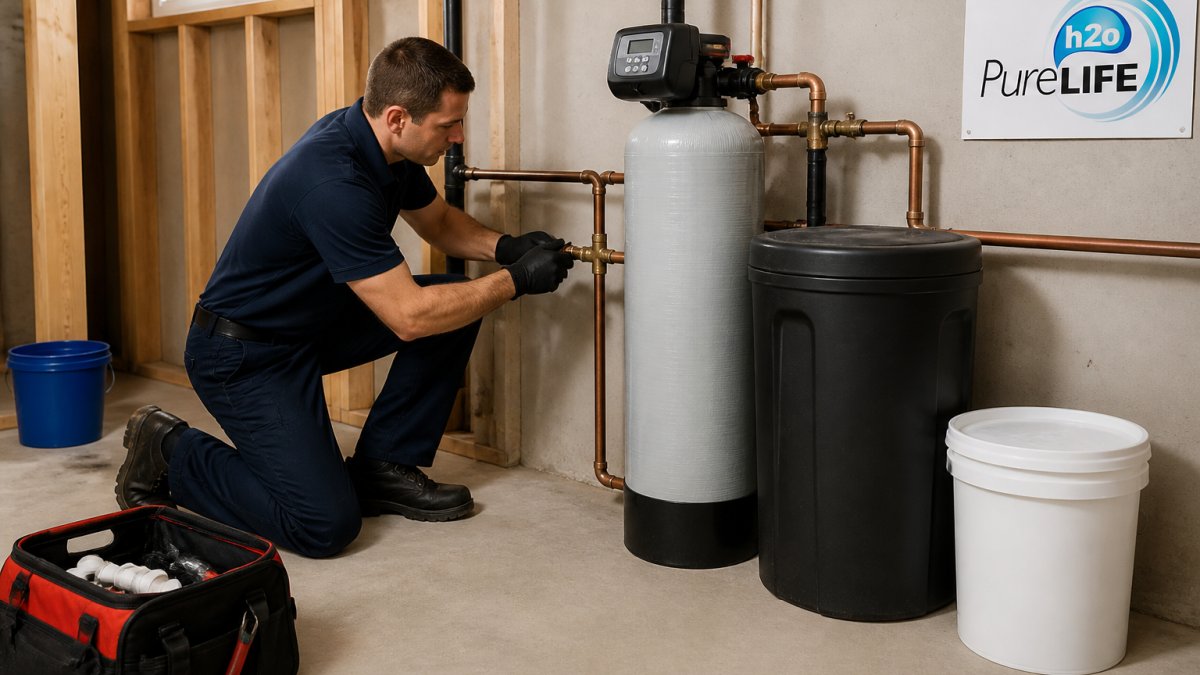
Here is how the visit usually goes:
- Water test and shutoff (15-20 minutes): Confirm hardness and iron levels, then shut off the main water.
- Mount and connect (60-90 minutes): Set the tank, connect the inlet and outlet, and install the bypass.
- Drain line and power (30-45 minutes): Run the drain line to a suitable point and plug in the unit.
- Program and test (20-30 minutes): Set the hardness, run a cycle, and check for leaks.
- Walkthrough (10 minutes): Show you how to add salt and what to watch for.
Water Softener Maintenance Cost Over the Life of the System
Water softener maintenance cost is mostly salt and the occasional service call. Salt is the ongoing expense, and how much you use depends on your water hardness, how many people live in the home, and how the unit is programmed.
The mechanism matters here. A softener regenerates by flushing a brine solution through the resin bed to strip off the calcium and magnesium it has collected.
Beyond salt, budget for:
- Annual or biennial service to check the resin, valves, and settings. Resin can last many years, but it can be degraded by chlorine, iron, or sediment if pre-treatment is missing.
- Replacement parts like seals, O-rings, and a control valve over time. The control valve is the most common failure point because it has moving parts and seals that wear.
- Resin replacement after many years of use, or sooner if the unit has been exposed to high iron or chlorine without protection.
- Pre-filter cartridges if your system includes a sediment or carbon filter ahead of the softener. These are inexpensive but need regular replacement to protect the resin.
A well-installed unit with a bypass valve is easier and cheaper to service, because the technician can isolate it without draining the whole system. That is one reason we insist on installing one.
How to Keep Maintenance Costs Low
The cheapest maintenance plan is prevention. Test your water before the unit is installed so it is sized correctly. Add pre-treatment if iron or chlorine is present. Keep the salt tank at least half full so the unit never runs dry. And check the brine tank for bridging or mushing every few months, especially in humid basements.
If you are on well water, retest annually. Hardness and iron levels can shift, and a unit that was perfectly sized two years ago may need a settings adjustment or a different pre-filter. That is a small cost that prevents a much larger one.
What a Water Softener Quote Should Include (and What to Question)
A complete quote should list the equipment, the labor, the bypass valve, the drain line, and any permit fees. If a line item is missing, ask about it before you sign.
Question these:
- A quote with no water test. Hardness and iron levels decide the system size.
- No mention of a bypass valve.
- No drain line in the scope.
- A price that seems too low with no detail on what is included.
For current pricing, request a quote from Pure Life H2O after your free water test.
Conclusion: Getting an Accurate Number for Your Home
The only accurate cost of water softener installation in 2026 comes from a quote built around your water and your home. Generic prices miss the plumbing, the hardness, and the extras that decide the real number.
Pure Life H2O has served over 4,000 customers with customized treatment plans, professional installation, and local service. We are an authorized Pentair dealer with more than 26 years of hands-on experience.
Get started with Pure Life H2O and get a free water test, a clear quote, and a system sized for your home.
Frequently Asked Questions
How much does it cost to install a water softener in 2026?
There is no single figure because the cost of water softener installation depends on the system type, your home's plumbing layout, and whether electrical or drain work is needed. A basic single-tank unit in an unfinished basement costs less to install than a dual-tank system that needs new piping runs. Request a free water test and written quote so the number reflects your actual setup rather than a generic estimate.
What factors affect the cost of water softener installation?
The main drivers are system type and capacity, where the unit will sit relative to your water main, whether a dedicated drain and power outlet already exist, and local plumbing permit requirements. Hard water severity also matters because it determines the system size you need. Homes with private well water may need iron or sulfur pretreatment added, which changes both the equipment and the install scope.
Is it cheaper to install a water softener yourself or hire a professional?
Doing it yourself saves the labor portion, but softener installation involves cutting into the main water line, soldering or press-fitting connections, and setting up a proper drain and bypass. A mistake can mean water damage or a voided manufacturer warranty. For most homeowners, professional installation costs more upfront but protects the equipment and the warranty, and it is usually done in a single visit.
How long does water softener installation take?
A straightforward swap in an unfinished basement with existing plumbing can be finished in a few hours. A first-time install that needs new piping, a drain line, or an electrical outlet typically takes most of a day. If your home has private well water and needs pretreatment equipment added, plan for a longer appointment. Your installer should confirm the expected timeframe in the quote.
A vague price is worse than no price. Get a free water test from Pure Life H2O, see exactly what your home needs, and get a quote with every line item spelled out. Our team handles the plumbing, the bypass, and the drain line in one visit, and we stand behind the work with local service and maintenance. Book your free water test and get an accurate number for your home.