 how-to
How to Remove Limescale from Faucets: A Step-by-Step Guide
Table of Contents
- Why Limescale Builds Up on Faucets and What It Does to Your Plumbing
- What You'll Need: Tools and Supplies for Descaling Faucets
- How to Remove Limescale from Faucets: Step-by-Step
- How to Remove Hardened Limescale from Faucets That Won't Budge
- How to Clean a Faucet Aerator (And Restore Weak Water Pressure)
- How Long to Leave Vinegar on a Faucet (and Finish-Specific Safety)
- How to Prevent Limescale Buildup on Faucets Long-Term
- Frequently Asked Questions
Last Updated: October 9, 2026
Why Limescale Builds Up on Faucets and What It Does to Your Plumbing
Limescale is the chalky white crust left behind when hard water dries on a surface. Water carries dissolved calcium and magnesium. When that water evaporates, the minerals stay put and harden into calcium deposits.
Those deposits do more than look bad. They clog aerator screens, dull faucet finishes, and cut water pressure over time.
If you have ever chipped a fingernail trying to scrape white film off a tap, you already know the problem. This guide walks through how to remove limescale from faucets safely, without wrecking the finish.
Below, we cover the tools you need, a step-by-step method, and the finish-specific rules most guides skip.
What You'll Need: Tools and Supplies for Descaling Faucets
You do not need a cabinet full of specialty products. A basic descaling kit covers almost every faucet in a home:
- White vinegar (the workhorse for most jobs)
- Citric acid powder (for stubborn or delicate finishes)
- Baking soda (for a gentle paste on thick crust)
- A plastic bag and a rubber band
- A non-abrasive sponge or soft cloth
- A nylon brush for threads and tight gaps
- A spray bottle
- A microfiber cloth for the final polish
- An old toothbrush for aerator screens
Safety note: skip steel wool and abrasive scouring pads. They scratch chrome and strip the protective coating on brushed or matte finishes.
A common mistake is grabbing the strongest cleaner on the shelf. In practice, the mildest option that works is the right one.
How to Remove Limescale from Faucets: Step-by-Step
The full process takes about 30 minutes, and most of that is soaking time. Here is how to remove limescale from faucets without damaging the finish.
Step 1: Prep the Area and Protect Your Finish
Start by drying the faucet. Dry surfaces let you see exactly where the mineral buildup sits. Then check what your fixture is made of. Chrome, brushed nickel, matte black, and oil-rubbed bronze all react differently to acids.
Cover the drain with a stopper so small parts do not disappear. If you plan to remove the aerator, note how it comes apart first.
Step 2: Apply Your Cleaning Solution
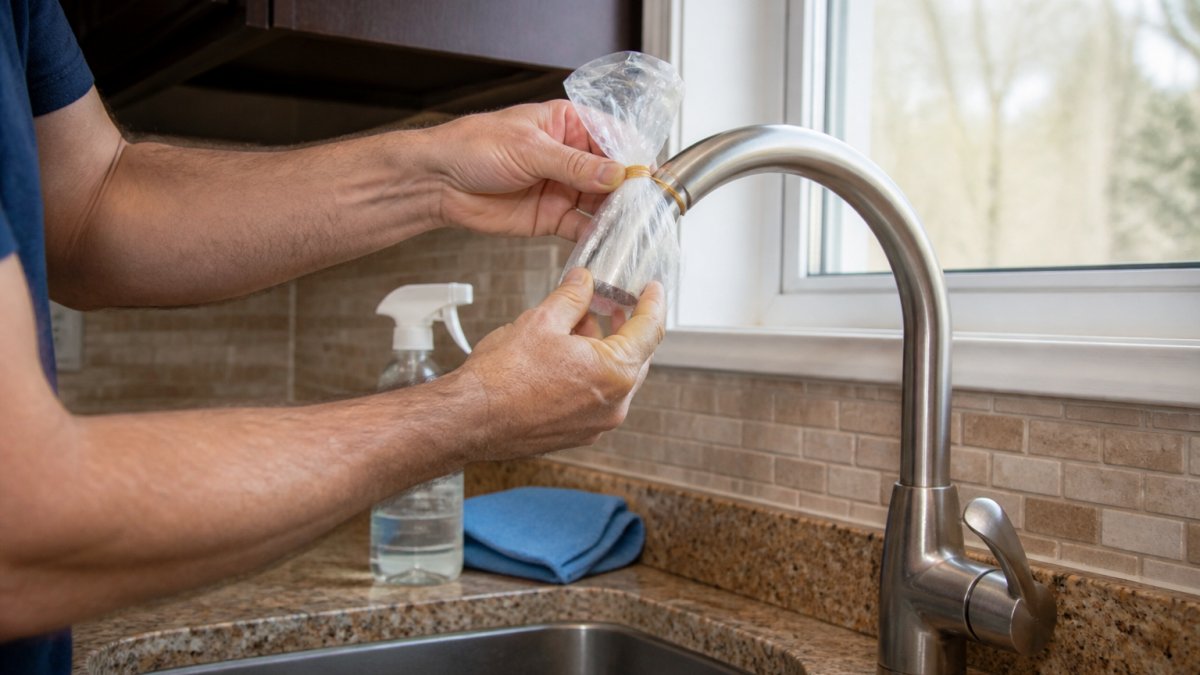
For most faucets, white vinegar does the job. Fill a plastic bag with vinegar, slip it over the spout, and hold it in place with a rubber band. The bag method keeps the aerator submerged and frees your hands.
For citric acid, mix a spoonful into warm water in your spray bottle. Spray the affected area and let it sit.
The soaking time does the work. Scrubbing too early just spreads the crust around.
Step 3: Scrub, Rinse, and Polish
After soaking, wipe the softened scale away with a non-abrasive sponge. Use a nylon brush on threads and around the base. Rinse with warm water, then dry with a microfiber cloth.
Drying matters. Water left to air-dry on a faucet leaves fresh mineral spots within hours.
| Step | What You Do | Time | Watch For |
|---|---|---|---|
| 1. Prep | Dry the faucet, check finish, stopper the drain | 5 min | Loose aerator parts |
| 2. Apply | Vinegar bag or citric acid spray | 2 min | Over-tightening the rubber band |
| 3. Soak | Let the solution break down the scale | 20-30 min | Soaking too long on delicate finishes |
| 4. Scrub | Non-abrasive sponge and nylon brush | 5 min | Abrasive pads |
| 5. Rinse and polish | Warm water, then microfiber dry | 3 min | Air-drying spots |
How to Remove Hardened Limescale from Faucets That Won't Budge
Hardened limescale needs more time, not more force. Thick white crust that has sat for months will not lift in a five-minute soak.
Try this sequence:
- Soak the area in vinegar for a full hour, or overnight for chrome.
- Make a baking soda paste and press it onto the crust.
- Spray the paste with vinegar to activate it, then let it fizz.
- Scrub gently with a nylon brush.
- Repeat if a thin ring of scale remains.
For very old deposits, citric acid is often stronger than vinegar and gentler on finishes. Warm water speeds up the reaction.
If scale keeps returning on the same fixture within weeks, that is a sign of hard water, not poor cleaning. A water test tells you what is actually in your supply.
How to Clean a Faucet Aerator (And Restore Weak Water Pressure)
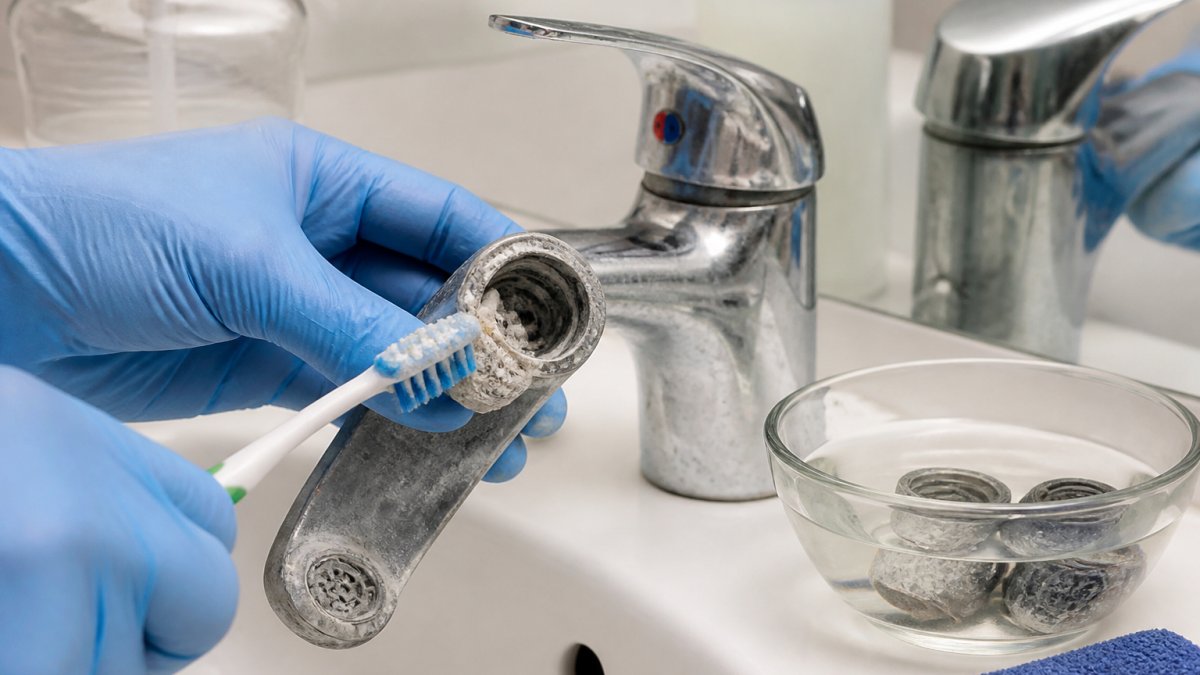
A clogged aerator is the most common cause of weak flow at a single tap. The screen traps mineral fragments, and over time those fragments block the openings.
Here is how to clean a faucet aerator:
- Unscrew the aerator by hand, or use a cloth and pliers for a stuck one.
- Take the parts apart and lay them out in order.
- Soak the screen and housing in vinegar for 30 minutes.
- Scrub the screen with an old toothbrush.
- Rinse, reassemble, and screw it back on.
Troubleshooting low water pressure: if flow is weak at one faucet only, the aerator is almost always the culprit. If pressure is low at every tap in the house, cleaning will not fix it. That points to the supply line or a system-wide mineral problem.
Hard water is a leading cause of recurring aerator clogs. If you are cleaning the same screen every few months, the buildup is coming from your water.
How Long to Leave Vinegar on a Faucet (and Finish-Specific Safety)
Twenty to thirty minutes handles most limescale. An hour is fine for chrome. Overnight soaks work on tough deposits, but only on durable finishes. The reason is simple: vinegar is acetic acid, and acid dissolves the calcium carbonate in scale.
Finish type changes the rules. Use this as your soak-time decision guide:
| Finish | Safe soak time | Best agent | Why |
|---|---|---|---|
| Chrome | Up to overnight | White vinegar | Hard, non-porous plating resists acid |
| Polished stainless | 30-60 min | Vinegar or citric acid | Resists acid but can spot if left wet |
| Brushed nickel | 15-20 min | Citric acid in warm water | PVD or lacquer topcoat can cloud |
| Matte black | 10-15 min | Citric acid, short contact | Powder-coat or paint dulls with acid |
| Oil-rubbed bronze | 5-10 min | Citric acid, spot test first | Living finish darkens and strips unevenly |
| Brushed gold or brass | 5-10 min | Citric acid, spot test first | Lacquer layer is thin and easily etched |
| Powder-coated or enameled | Avoid acid | Mild soap and soft cloth | Coating can chip or discolor |
A few rules that apply to every finish:
- Test on a hidden spot first, such as the underside of the spout or the back of the handle.
- Never leave a vinegar-soaked rag or bag on a finish longer than the table allows, even if the scale is still visible.
- Rinse with warm water the moment the soak ends. Acid keeps reacting as long as it sits.
- Dry immediately with a microfiber cloth. Air-drying leaves fresh mineral spots and can leave water marks on plated surfaces.
If you see a dull patch, a cloudy haze, or a color shift after soaking, stop. Rinse thoroughly, dry the surface, and apply a non-abrasive wax or a manufacturer-approved polish. Do not try to buff out the mark with an abrasive pad. That removes more of the topcoat and makes the damage worse.
How to Prevent Limescale Buildup on Faucets Long-Term
Cleaning removes scale. Prevention stops it from forming in the first place. The difference comes down to your water, and specifically to two numbers: total hardness and alkalinity.
A few habits help between deep cleans:
- Dry faucets and shower heads after use with a microfiber cloth.
- Wipe down fixtures weekly to stop mineral residue from setting.
- Run a monthly vinegar soak on high-use taps.
- Keep an eye on aerators before flow drops.
- Set your water heater no higher than 49°C (120°F) to slow scale formation in the tank and lines.
These steps slow the buildup. They do not remove the minerals that cause it. If you are descaling the same faucet every few weeks, habits alone will not solve the problem.
For a permanent fix, treat the water itself. The main options are:
- Ion-exchange water softener: removes calcium and magnesium by swapping them for sodium or potassium. Best for whole-home hardness above roughly 7 gpg. Requires salt refills and a drain connection.
- Salt-free conditioner (template-assisted crystallization): changes how minerals behave so they are less likely to stick to surfaces. No salt, no drain, but it does not remove hardness and results vary by water chemistry.
- Reverse osmosis (RO) system: point-of-use treatment that removes the vast majority of dissolved minerals and other contaminants. Ideal for drinking water, not for whole-home scale control.
- Inline or whole-home filter: captures sediment and some minerals but is not a true softener. Useful as a pre-filter ahead of a softener or RO unit.
Choosing between them comes down to three questions: how hard is your water, how much water do you need to treat, and what is your budget for maintenance?
Testing is the only way to know what you are dealing with. A laboratory water test reports hardness, alkalinity, pH, iron, manganese, and other parameters that affect how scale forms and how well treatment will work. Health Canada guidance on drinking water quality is a useful starting point for understanding what is in your supply and what is regulated.
At Pure Life H2O, we have spent over 26 years testing and treating water for homes across the GTA.
Frequently Asked Questions
What dissolves calcium buildup on faucets?
White vinegar and citric acid are the most effective household options. Both are mild acids that break down the calcium carbonate in limescale without scratching chrome or brushed nickel. For light buildup, a 30-minute vinegar soak works. For heavier mineral deposits, leave it on for several hours or overnight. Baking soda works as a gentle abrasive paste for scrubbing after the acid soak has loosened the scale.
Can vinegar damage a faucet finish?
Vinegar can damage certain finishes if left too long. Chrome, brushed nickel, and stainless steel handle short soaks well, but avoid leaving vinegar on gold, brass, copper, or oil-rubbed bronze for more than 15 to 20 minutes. Always rinse thoroughly with water afterward. If you're unsure about your faucet's finish, test a small hidden area first or use a citric acid solution instead, which is gentler on delicate coatings.
How often should you descale faucets?
In hard water areas, descale faucets every four to six weeks to stop mineral buildup from hardening. If you notice white spots, reduced water pressure, or a chalky film within days of cleaning, your water hardness is high enough that a water softener or whole-home filtration system will save you hours of repeat scrubbing. A free water test can confirm your exact hardness level.
How do you clean limescale from a faucet aerator?
Unscrew the aerator from the faucet tip, then soak it in a 50/50 mix of white vinegar and water for 30 minutes to an hour. Use an old toothbrush or nylon brush to scrub the mesh screen and the inside threads. Rinse under running water, then reattach. If the aerator is seized with scale, wrap it in a vinegar-soaked cloth for 20 minutes before unscrewing to loosen the mineral bond.
Limescale will keep coming back as long as hard water runs through your pipes. Cleaning buys you weeks. Treatment solves it for good. Pure Life H2O offers free water testing, customized treatment plans, and full installation and maintenance, backed by 26 years of experience and more than 4,000 customers served. Get your free water test and stop descaling the same faucet every month.