 blog
How to Compare Kinetico and Lifetime Water Systems
Last Updated: October 28, 2026
Quick Summary
Kinetico vs Lifetime is hard to settle on brand claims alone, because no verified like-for-like comparison of the two brands exists. The better approach is to test your water first, then compare the specific Kinetico and Lifetime models proposed for your home on the same factors: control type, tank design, sizing, regeneration water use, warranty and local service.
- Brand reputation is the least useful input when comparing softener systems.
- Test your water first to confirm hardness and whether iron or sulphur is present.
- Ask each dealer to fill in the same comparison table for the model they recommend.
- Compare regeneration water use and salt use, since both drive ongoing costs.
- Read the warranty for parts and labour coverage, exclusions and transferability.
Table of Contents
- Why Kinetico vs Lifetime Water Systems Is Hard to Settle on Paper
- Understanding Water Softener Types and Design Differences
- What to Compare: Lifespan, Regeneration Water, Controls and Service
- Whole-Home Water Filtration vs Reverse Osmosis: Which Do You Need?
- Keeping Any Water Treatment System Running Well
- Questions to Ask a Water Treatment Company Before You Buy
- Book a Water Test Before Choosing Your Next Step
- Frequently Asked Questions
Why Kinetico vs Lifetime Water Systems Is Hard to Settle on Paper
Comparing Kinetico and Lifetime Water Systems sounds simple until you look for evidence, and few shoppers searching for kinetico vs lifetime find any.
Pure Life H2O has over 26 years of experience in water treatment.
Hard water is the most common reason homeowners look at softeners. Limescale on shower heads, spotted glassware and dry skin are the usual symptoms.
Understanding Water Softener Types and Design Differences
A water softener removes hardness minerals, mainly calcium and magnesium, by passing water through resin beads that exchange them for sodium or potassium. You can see the full range of water softener options we offer to compare designs. Once the resin is saturated, the system regenerates by flushing it with brine, which strips the hardness minerals off and sends them to drain.
Ion exchange in plain terms
Resin beads carry sodium or potassium ions. As hard water passes through, calcium and magnesium bind to the resin and the sodium or potassium is released. When the resin is full, brine from the salt tank reverses the exchange and the hardness minerals are rinsed away. Softeners need salt because it is the source of the exchange ions, not a filter that gets used up.
Dual-tank versus single-tank
- Single-tank: One resin tank. Compact and usually less expensive. During regeneration, softening pauses, so a household drawing water at that moment may notice hardness or a brief pressure change.
- Dual-tank: Two resin tanks that alternate. One tank softens while the other regenerates, so soft water is available continuously. This matters in busy households with multiple bathrooms, or where laundry and showers overlap.
Dual-tank designs take more floor space and generally cost more, so the trade-off is continuous supply versus footprint and price.
Water-powered versus electric controls
- Water-powered controls use the flow of water through the valve to drive regeneration. They need no electrical connection at the unit, which can simplify installation in a utility room without a nearby outlet. They are metered by flow, so regeneration tracks water use.
- Electric controls use a timer or a sensor and allow programmable hardness settings, service alerts and finer tuning. They require power at the installation point.
Neither is inherently better; the right choice depends on installation space, preference for programmability, and how the unit will be serviced.
Capacity and sizing: the numbers that decide performance
Capacity is expressed as grains of hardness removed per regeneration at a stated salt dose. Two systems with the same tank size can have different rated capacities depending on salt dose, so capacity without a salt dose is an incomplete number.
A practical sizing approach:
- Confirm hardness with a water test, in grains per gallon or milligrams per litre as calcium carbonate.
- Estimate daily household demand. A common planning figure is about 75 to 100 litres per person per day for indoor use, adjusted upward for large families, frequent laundry, or homes with multiple bathrooms in heavy use.
- Multiply daily demand by hardness to estimate daily grain removal.
- Size capacity so the system does not regenerate every day, while avoiding a unit so large it sits with stale water.
An undersized unit regenerates too often, wasting salt and water and shortening resin life. An oversized unit may use more salt per regeneration than necessary. Correct sizing is a calculation, not a guess.
What Ontario water typically throws at a softener
Municipal supplies in the Greater Toronto Area are generally hard, and hardness varies by source and season. Private wells add complications: iron and manganese can foul resin, sulphur creates odour and can accelerate wear, and hardness may be higher. A softener alone does not address iron, sulphur or microbiological risks; those need pretreatment, oxidation, filtration or disinfection depending on test results.
Matching design to household
A single person in a condo may be well served by a compact single-tank, metered unit. A family of five with three bathrooms, a well and high laundry volume may need a dual-tank system with pretreatment for iron. Design questions only become answerable once hardness, water source and household demand are known, and our technicians can walk through how each option applies to a specific home after testing.
What to Compare: Lifespan, Regeneration Water, Controls and Service
Most brand comparisons stop at reputation. That is the least useful input. What actually separates two softener brands in daily ownership is how each one regenerates, how it is sized, what it consumes, and who stands behind it. Use the framework below to compare Kinetico and Lifetime Water Systems on equal terms, and insist on written answers rather than brochure language.
Build a side-by-side comparison sheet
Before you talk to either dealer, open a spreadsheet with these rows. Fill in the same fields for both brands using the model each dealer proposes for your home.
| Comparison factor | What to record | Why it matters |
|---|---|---|
| Control type | Water-powered (metered by flow) or electric (timer or sensor) | Determines whether regeneration tracks actual water use or a clock |
| Tank configuration | Single-tank or dual-tank | Dual-tank designs can keep soft water flowing during regeneration |
| Regeneration trigger | Metered, demand-initiated, or timed | Demand-initiated regeneration usually wastes less salt and water |
| Rated capacity | Grains of hardness removed per regeneration, at the stated salt dose | Capacity only means something paired with a salt dose |
| Flow rate | Continuous flow and peak flow ratings | Undersized flow rates show up as pressure drop at showers and appliances |
| Resin volume | Cubic feet of resin | More resin generally means longer runs between regenerations |
| Regeneration water use | Litres discharged per regeneration | Directly affects water and sewer charges |
| Salt use | Kilograms per regeneration at the rated dose | Drives ongoing consumable cost |
| Warranty terms | Years covered, parts versus labour, exclusions | A long parts warranty with no labour coverage is not the same as full coverage |
| Service model | Who performs repairs and how response is handled | Local service access often matters more than the badge on the valve |
Lifespan and reliability: read the warranty, not the marketing
Stated lifespans are manufacturer claims that assume proper sizing, clean resin and routine service. The warranty document is the more concrete signal: read it for years covered, whether parts and labour are both included, what voids coverage (for example, untreated iron or sulphur fouling the resin), and whether coverage transfers if you sell the home. A warranty that excludes labour can still leave you paying for every service visit.
Regeneration mechanics and water use
Every softener eventually regenerates, and the method shapes convenience and consumption.
- Timed regeneration runs on a clock, whether or not you used much water. It is simple but can regenerate a half-full resin bed.
- Demand-initiated (metered) regeneration counts the water passing through and regenerates when capacity is nearly spent. This is the common pattern in modern systems and generally uses less salt and water.
- Water-powered controls use the kinetic energy of flowing water to drive the valve, so they need no electrical connection at the unit. That can simplify installation in a basement or utility room without a nearby outlet.
Ask for the regeneration water volume for the specific model and sizing proposed, then compare it against your household's monthly water use. A softener that regenerates more often than necessary shows up on your utility bill.
Sizing: the step most comparisons skip
A softener is sized on two numbers: your water hardness (in grains per gallon or milligrams per litre as calcium carbonate) and your household's daily water demand. A rough planning figure many installers use is about 75 to 100 litres per person per day for indoor use, adjusted upward for large families, frequent laundry, or homes with multiple bathrooms in heavy use. Properly sizing your equipment ensures that you maintain a consistent supply of cleaner water for home use while extending the operational lifespan of your resin beds.
An undersized unit regenerates too often, wasting salt and water and shortening resin life. An oversized unit can sit with stale water in the tank and may use more salt per regeneration than needed. Correct sizing is a calculation, not a guess, which is why a water test and a household interview come before any quote.
Controls, programming and service access
Check how the control head is programmed, whether hardness can be adjusted after installation, and whether the unit displays service alerts or error codes. Then ask who performs repairs locally, what the typical response time is, and what routine maintenance involves (salt refills, resin inspection, valve checks, brine tank cleaning). In a region with hard municipal water and a mix of private wells, a system that is difficult to service becomes a liability.
Installed cost and ownership cost
Sticker price is only the first line. Ask for an itemized installed quote covering the unit, labour, plumbing modifications, permits if required, and startup. Then estimate ongoing costs: salt, any filter media, and service visits. Compare total ownership over the expected service life rather than the purchase price alone.
Whole-Home Water Filtration vs Reverse Osmosis: Which Do You Need?
Water softeners solve hardness. They do not remove most contaminants from drinking water and are not designed to address microbiological risks. For a side-by-side look at what each removes, costs and needs, see reverse osmosis vs whole-home filtration.
- Whole-home carbon filtration reduces chlorine, chloramine, taste and odour across all taps. It improves the water you bathe in, wash with and cook with, but it does not soften water.
- Reverse osmosis (RO) forces water through a fine membrane to remove a wider range of dissolved contaminants. RO is usually installed at a single tap for drinking and cooking water, and it produces less water than the tank can supply at once.
- Combined systems can pair a softener or whole-home filter with an RO unit for drinking water. This is often the right answer for families who want soft water throughout the house and higher-purity drinking water.
Before choosing, test your water. A test identifies which contaminants are present and at what levels, so you buy treatment that matches the problem.
Keeping Any Water Treatment System Running Well
Whatever system you choose, regular maintenance keeps it working as designed; a neglected system can lose performance quietly.
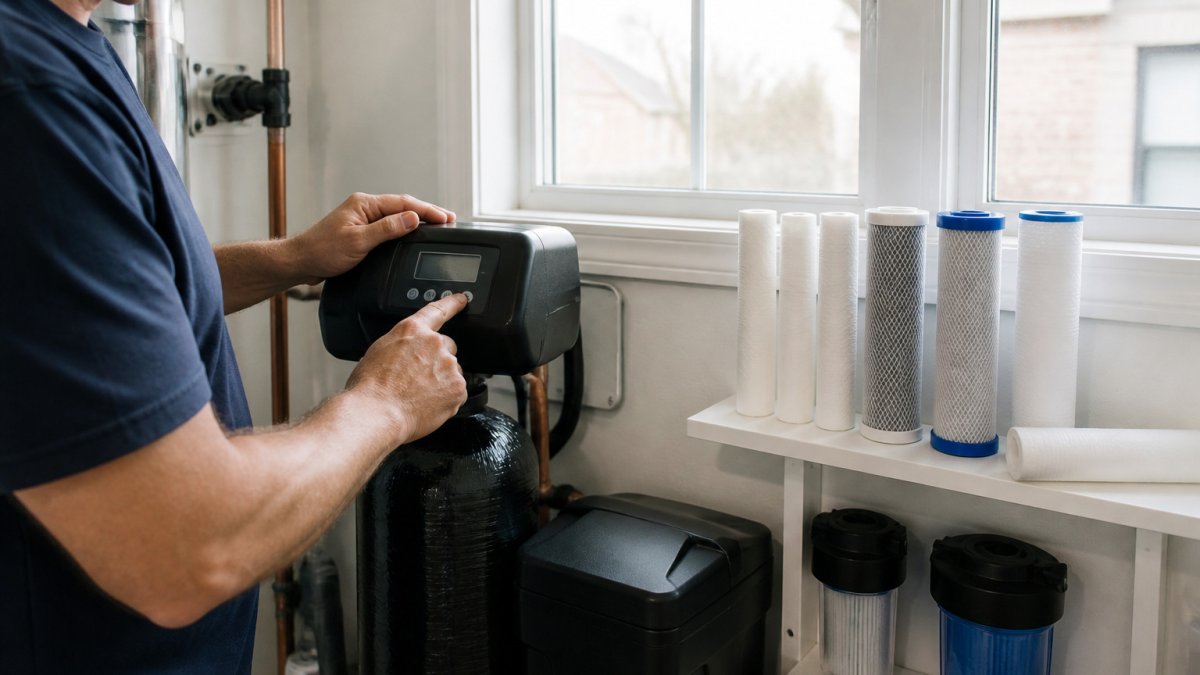
A basic maintenance routine typically includes:
- Checking salt levels in a softener and refilling before they run low.
- Replacing sediment and carbon filter cartridges on the schedule the manufacturer specifies.
- Confirming the control head displays the correct date, time and hardness setting.
- Checking for leaks around fittings and the bypass valve.
- Scheduling a professional inspection at least once a year.
Keep a simple log of salt refills, filter changes and service visits. It makes troubleshooting faster and helps prove the system was maintained if you ever file a warranty claim. Pure Life H2O offers maintenance, repair and filter replacement.
Questions to Ask a Water Treatment Company Before You Buy
A good installer should answer these questions clearly. If they cannot, consider it a warning sign. You can review our water testing service to see exactly what testing covers before you commit.
- What does the water test include? Ask whether testing covers hardness, iron, sulphur, chlorine and bacteria, and whether the results will be shared in writing.
- Is the quote itemized? Confirm what is included in the unit price, installation labour, plumbing, permits and first-year service.
- What warranty applies? Ask for the warranty terms for both the equipment and the installation workmanship.
Pure Life H2O is an authorized Pentair dealer. We build customized treatment plans based on individual water tests, and we provide comprehensive local service, maintenance and troubleshooting across the GTA. Learn more about our water treatment service and what the scope of work includes.
Book a Water Test Before Choosing Your Next Step
The most useful next step is knowing exactly what is in your water. Our free in-home water test gives you a clear picture of hardness and other concerns, so you can compare options based on your home rather than someone else's experience.
Once we have your results, our team can explain which system fits your goals and answer your questions about lifespan and service. Book your free water test and consultation today, and make your decision with real data in hand.
Frequently Asked Questions
What is the difference between Kinetico and Lifetime Water Systems?
The practical way to decide is to compare written quotes side by side for the same household water test results, the same included equipment, the warranty and the local service commitment. Pure Life H2O offers a free water test.
How do I choose between a water softener and whole-home filtration?
A water softener addresses hardness, the minerals that cause limescale on fixtures, faucets and appliances. Whole-home filtration, typically carbon-based, targets chlorine, chloramine, taste and odour. Many homes with hard water also have taste or odour concerns, so the right answer depends on your water test results rather than a general rule. Ask for a test that reports hardness, iron, sulphur, chlorine and any other parameters that matter for your supply before deciding. Pure Life H2O offers a free water test and can recommend which combination fits your home.
Does a water softener remove chlorine or other contaminants?
A standard water softener is designed to remove hardness minerals, mainly calcium and magnesium, through ion exchange. It is not designed to remove chlorine, chloramine or most other contaminants. Those are typically handled by carbon filtration, and drinking-water-grade reverse osmosis addresses a broader set of dissolved substances at the point of use. Treatment should match what your water test shows. Pure Life H2O can review your results and explain which equipment addresses each concern.
Should I test my water before choosing a treatment system?
Yes. Water quality differs between municipal supplies and private wells, and a test is the only reliable way to know whether you have hard water, iron, sulphur, bacteria or other concerns. Testing also prevents buying equipment that does not address the actual problem. Pure Life H2O offers a free water test and consultation.