 blog
Best Reverse Osmosis System for 2026
Table of Contents
- What Makes a Reverse Osmosis System Worth Choosing
- Best Under-Sink Reverse Osmosis System for Compact Spaces
- Tankless Reverse Osmosis System: Speed and Storage Trade-offs
- Reverse Osmosis System Installation Cost and What Affects It
- Reverse Osmosis Filter Replacement: Timing and Maintenance
- Contaminant Removal and Filtration Performance You Can Count On
- Water Waste, Efficiency, and Total Cost of Ownership
- Conclusion
- Frequently Asked Questions
Last Updated: October 12, 2026
What Makes a Reverse Osmosis System Worth Choosing
A reverse osmosis system forces tap water through a semi-permeable membrane under pressure, removing dissolved solids, contaminants, and impurities for cleaner-tasting water than untreated municipal or well water.
At Pure Life H2O, we've spent over 26 years helping homeowners understand why a reverse osmosis system makes sense: it removes contaminants like lead, chlorine, and bacteria that affect health and appliance longevity.
The best reverse osmosis system depends on three factors: water source (municipal or well), available space, and daily filtered water needs.
Best Under-Sink Reverse Osmosis System for Compact Spaces
Under-sink reverse osmosis systems are the most popular choice for filtered drinking water without renovating your plumbing.
The advantage is simplicity: installation doesn't require running new water lines through walls or disrupting your main water supply.
Look for multiple filtration stages: a sediment filter for particles, an activated carbon filter for chlorine and odors, the reverse osmosis membrane itself, and a post-filter for final polishing.
Storage tank capacity matters: a standard under-sink system holds approximately 11.4 litres (3 gallons), so heavy users will notice the tank refilling throughout the day.
Tankless Reverse Osmosis System: Speed and Storage Trade-offs
The trade-off is flow rate: without a pressurized tank, a tankless system produces water more slowly and works harder during peak usage.
Tankless models also waste more water: a standard tank-based system typically runs a 3:1 waste-to-pure ratio, while tankless systems often run 4:1 or higher.
For severe space constraints, condos, apartments, or kitchens where even a compact tank won't fit, tankless systems can be a good option.
Reverse Osmosis System Installation Cost and What Affects It
Installation cost for a reverse osmosis system depends on system type, plumbing configuration, whether new water lines are needed, and local labor rates. Under-sink installation typically requires less work than whole-home, but complexity varies.
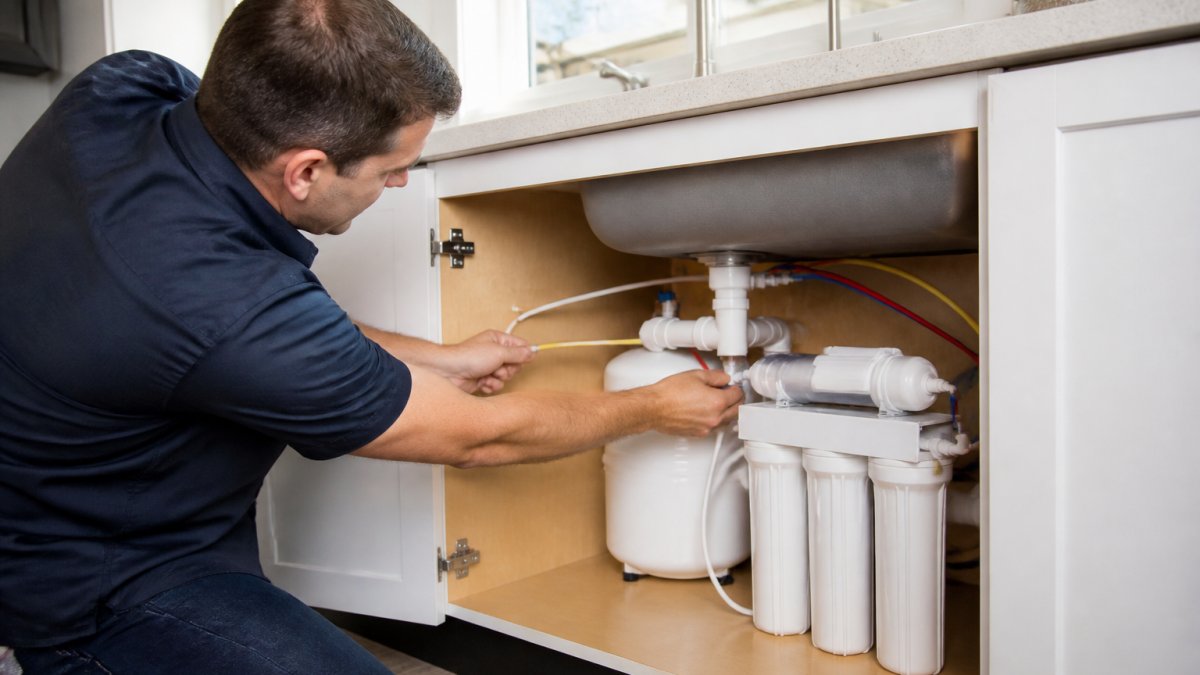
The primary variables that affect installation cost are:
- System type: Under-sink systems are simpler to install than whole-home systems
- Existing plumbing: Homes with accessible water lines cost less to retrofit
- Water source: Municipal water requires different setup than private well water
- Faucet installation: Adding a dedicated faucet adds to labor time
- Accessibility: Tight spaces or difficult-to-reach areas increase installation complexity
What Actually Drives the Quote
Most quotes break down into parts, labor, and pre-treatment for your source water. A standard under-sink job needs a feed-water adapter, drain saddle, dedicated faucet, and tubing.
Space under the sink matters as much as plumbing. A tank-based system needs room for the tank plus filter housings and membrane. A tankless unit trades tank space for a larger manifold and usually needs a nearby outlet, since many models use a pump or booster. No outlet means an electrician, a separate trade with a separate charge.
Plumbing and Compatibility Constraints
- Faucet hole: A dedicated RO faucet needs its own hole. Some homeowners replace a soap dispenser or a sprayer to avoid drilling.
- Drain connection: The system needs a drain line for reject water. A saddle valve or a dishwasher-style wye fitting is common; a garbage disposal can complicate routing.
- Water pressure: Most residential RO membranes are rated for a feed pressure in the range of roughly 40-80 psi. Below that, a booster pump is often recommended; above it, a pressure regulator protects the membrane. According to Health Canada's guidelines on drinking water quality, maintaining adequate water pressure is crucial for efficient system operation.
- Rental and condo constraints: If you rent or live in a building with shared plumbing, drilling a faucet hole may need landlord or strata approval. Portable countertop RO units avoid drilling entirely, at the cost of smaller capacity and slower output.
- Well water: Private well water often carries iron, manganese, sulfur, or hardness that should be treated ahead of the RO membrane. Skipping pre-treatment shortens membrane life and increases long-term cost.
Certification and Claim Verification
When comparing quotes, ask what the system is certified to. In North America, the relevant third-party standard for point-of-use RO systems is NSF/ANSI 58, covering contaminant reduction, structural integrity, and material safety. Information on NSF/ANSI standards
For professional installation, get a free water test first. It identifies exactly which contaminants you're dealing with and whether a reverse osmosis system is the right choice or another treatment makes more sense. At Pure Life H2O, we offer free water testing before any investment.
Reverse Osmosis Filter Replacement: Timing and Maintenance
A reverse osmosis system requires regular filter changes. Most homeowners replace filters annually, though timing depends on water quality and usage: sediment and carbon pre-filters every 6-12 months, and the reverse osmosis membrane every 2-3 years.
Replacement filters are inexpensive insurance compared to bottled water or appliances damaged by mineral buildup.
Set a calendar reminder for filter changes, or rely on systems with indicator lights. Pure Life H2O provides maintenance reminders and can handle filter replacement during regular service visits.
Contaminant Removal and Filtration Performance You Can Count On
A quality reverse osmosis system removes a high percentage of dissolved solids and common contaminants: lead, chlorine, bacteria, viruses, fluoride, nitrates, pesticides, and pharmaceutical residues. The membrane's pores are roughly 0.0001 microns, blocking particles that pass through other filters.
However, not all reverse osmosis systems perform identically. Membrane quality, water pressure, and pre-filtration stages affect removal efficiency. Poor pre-filtration clogs the membrane faster and shortens its lifespan; inadequate pressure means slower flow and lower removal rates.
Read the Certification, Not the Marketing
The single most useful comparison tool is the certification listing. In North America, point-of-use RO systems are typically certified to NSF/ANSI 58, which tests contaminant reduction, structural integrity, and material safety. Related standards cover specific claims:
- NSF/ANSI 42, aesthetic effects: chlorine taste and odor, particulates.
- NSF/ANSI 53, health effects: lead, cysts, volatile organic compounds, and others.
- NSF/ANSI 58, the RO-specific standard, covering the full system including the membrane.
- NSF/ANSI 401, emerging contaminants such as some pharmaceuticals and personal care products.
A manufacturer's performance data sheet lists each contaminant, the influent challenge concentration, and the percent reduction achieved. That is the document to compare model to model. A system that says "removes up to 99%" without a data sheet is making a marketing claim, not a verified one.
Why Two Systems With the Same Membrane Perform Differently
The membrane is only one stage. Real-world performance depends on the whole train:
- Pre-filtration: Sediment and carbon stages protect the membrane. If they load up, the membrane sees more fouling and produces lower-quality water.
- Feed pressure and temperature: Cold water and low pressure reduce production and can lower rejection rates. A booster pump helps in low-pressure homes.
- TDS and source water: Higher feed-water TDS means the membrane has more to reject. Well water with iron, manganese, or hardness needs pre-treatment or the membrane fouls quickly.
- Post-filtration and remineralization: A post carbon filter polishes taste. Remineralization adds back minerals like calcium and magnesium; it does not add contaminants, but it does raise TDS slightly, which is why a TDS meter reading after remineralization is not a measure of purity.
A Model-by-Model Comparison Approach
Rather than trusting a single headline number, compare systems on four data points:
- Certified contaminants and reduction levels from the performance data sheet.
- Rated daily production in litres per day at a stated pressure and temperature. Understanding RO system capacity
- Recovery rate, the percentage of feed water that becomes product water.
- Replacement interval and cost for each stage.
That combination tells you more than any "stages" count: a five-stage system with a poorly matched membrane can underperform a well-certified three-stage unit.
Your water quality matters too. Municipal water is generally well-treated, but private well water often contains iron, sulfur, bacteria, or hardness requiring different pre-treatment before reverse osmosis filtration. Testing your water first, not guessing, leads to the right system choice. According to Environment and Climate Change Canada on water quality standards, understanding your local water composition is key.
Water Waste, Efficiency, and Total Cost of Ownership
Reverse osmosis systems produce waste water during filtration.
That waste water isn't truly wasted; many homeowners use it for plants or cleaning. Still, the efficiency ratio matters for your water bill and environmental impact.
Total cost of ownership includes purchase price, installation, annual filter replacements, and water waste.
Consider how long you'll stay in your home: moving within a few years might favor a modest under-sink system, while staying long-term might favor a system with lower operating costs.
Conclusion
Choosing the best reverse osmosis system for 2026 comes down to matching your water quality issues with the right filtration approach.
The difference between a system that works and one that disappoints is often professional installation, proper pre-testing, and ongoing maintenance.
Get your free water test and discover what's actually in your tap water.
Reverse Osmosis System Type | Best For | Key Consideration |
|---|---|---|
Under-sink system | Drinking water and cooking | Limited storage tank capacity |
Tankless system | Compact spaces | Slower flow rate |
Whole-home system | Hard water and mineral buildup | Higher installation cost |
Well water system | Private water sources | Requires pre-treatment |
Additional Resources:
According to Health Canada's guidelines on drinking water quality, reverse osmosis is recognized as an effective treatment method for removing contaminants from residential water supplies.
Research from Environment and Climate Change Canada on water quality standards shows that many municipalities recommend point-of-use treatment like reverse osmosis for homeowners concerned about specific contaminants.
For homeowners with private wells, Ontario Ministry of the Environment guidelines on private well water testing recommends regular water testing and appropriate treatment systems to ensure safe drinking water.
Frequently Asked Questions
Does a reverse osmosis system actually remove lead and other harmful contaminants?
Yes, reverse osmosis systems remove lead, chlorine, bacteria, and many dissolved minerals through their multi-stage filtration and semi-permeable membrane. The membrane blocks particles and contaminants larger than water molecules, achieving up to 99.99% removal of certain pollutants. However, effectiveness depends on the specific contaminants in your water and the system's maintenance schedule. Water testing before and after installation confirms what your system removes.
How much does it cost to install a reverse osmosis system?
Installation costs depend on your home's plumbing configuration, whether you choose an under-sink or whole-home system, and local labour rates. Professional installation ensures proper connections and system performance. Costs also vary based on whether additional pre-filters or post-filters are needed for your water quality. Get a free water test and quote to understand the total investment for your specific situation.
How often do reverse osmosis filters need to be replaced?
Sediment and carbon pre-filters typically need replacement every 6 to 12 months, depending on your water quality and usage. The reverse osmosis membrane itself can last 2 to 5 years with proper maintenance. Post-filters may need annual replacement. Regular filter changes maintain water quality and prevent system damage. Your water quality and household usage determine the exact replacement schedule for your system.
Is a tankless reverse osmosis system better than one with a storage tank?
Tankless systems produce filtered water on demand without storage, saving space and reducing water sitting in a tank. However, they have slower flow rates, so you wait longer for water. Tank-based systems store filtered water and deliver it quickly but require cabinet space. The choice depends on your kitchen layout, how much filtered water you use daily, and whether you prioritize speed or space savings. Each type has distinct advantages for different households.
Looking for a Reverse Osmosis System in Toronto & the GTA?
Pure Life H2O offers professional installation of Pentair MR-1 alkaline reverse osmosis drinking water systems. Enjoy great-tasting filtered water with expert installation and local service throughout Toronto and the GTA.