 how-to
How to Choose a Whole Home Water Filter for City Water
Last Updated: October 23, 2026
Quick Summary
To choose a whole home water filter for city water, start by testing your tap and reading your municipal water quality report, then match the filter media to the contaminants you actually have. Size the system for peak flow and pressure drop, confirm certification names the specific contaminant, and plan cartridge maintenance before you buy.
- Test your kitchen tap and read the municipal report together, since the report cannot show what happens inside your plumbing.
- Hardness above roughly 120 mg/L points to a softener, which is a separate system from a whole-home filter.
- Size the system's rated service flow at or above your peak simultaneous demand, not your average daily use.
- Compare systems at the same stated pressure drop, because a clogged cartridge adds more resistance.
- Check that certification names the standard and exact contaminant, and confirm a bypass valve for service.
Table of Contents
- Step 1: Start With Water Testing for City Water
- Step 2: Match Filter Media to the Contaminants You Want Gone
- Step 3: Size the Whole Home Water Filter for Peak Flow and Pressure
- Step 4: Decide Between a Whole-House Filter vs. Reverse Osmosis
- Step 5: Check Certification Claims and What the System Cannot Remove
- Step 6: Plan Whole-House Water Filter Maintenance Before You Buy
- Frequently Asked Questions
Step 1: Start With Water Testing for City Water
The right way to choose a whole home water filter for city water starts with testing, not shopping.
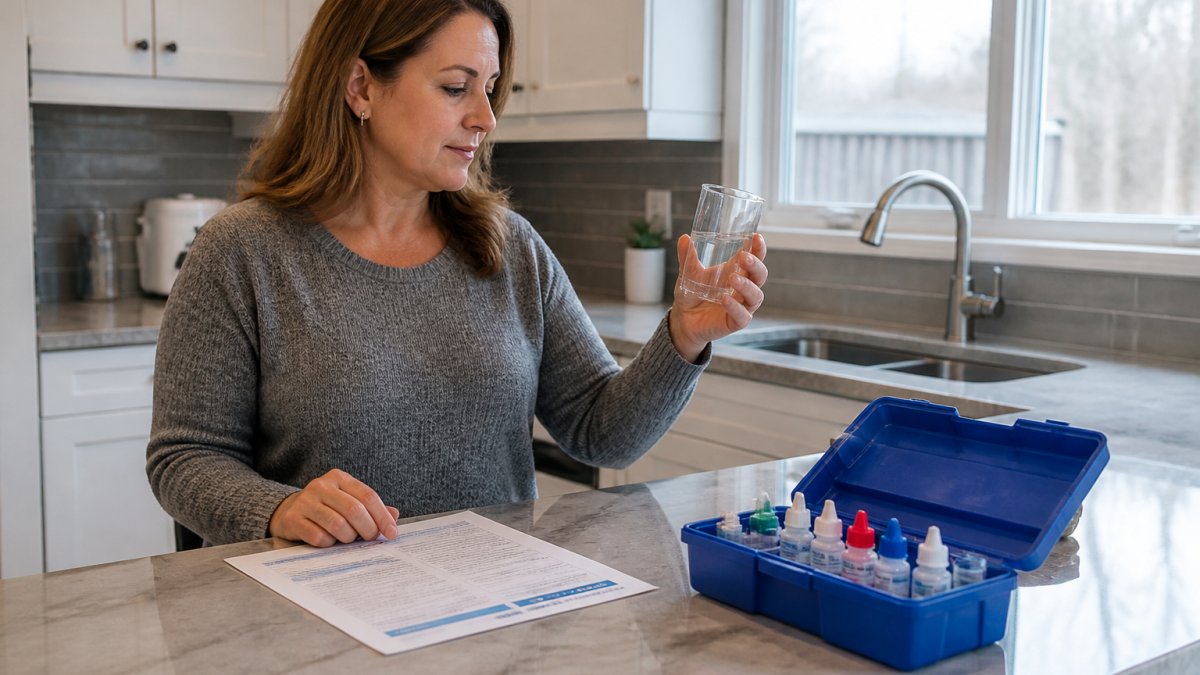
Start with a sample from your own kitchen tap. If you would rather not assemble a test kit yourself, you can GET YOUR FREE WATER TEST and have a technician sample your tap directly.
Reading Your Municipal Water Quality Report
Every municipal water system publishes an annual water quality report. In Ontario, these are often called the annual drinking water system report or consumer confidence report. It lists detected contaminants, their measured levels, and the health-based limits they are compared against.
Here is a practical way to work through a report:
- Find the source. Note whether your water comes from a lake, a river, or groundwater. Source water shapes which contaminants are likely: surface water tends to carry more disinfection byproducts and seasonal organics, while groundwater can carry hardness, iron, and naturally occurring metals.
- Identify the disinfectant. Chlorine and chloramine behave differently in a filter. Standard activated carbon handles chlorine well; chloramine usually needs catalytic carbon. The report names the disinfectant and its residual range.
- Look at disinfection byproducts. Total trihalomethanes and haloacetic acids form when disinfectants react with organic matter (Draft Guidelines for Canadian Drinking Water Quality, Haloacetic Acids). They are regulated, and carbon filtration is the common residential reduction step.
One caveat matters more than any other: a water quality report describes water leaving the treatment plant. It cannot tell you what happens inside your home's plumbing.
Turning Test Results Into a Filter Shortlist
Once you have both documents, translate them into a shortlist instead of a shopping list:
- Hardness above roughly 120 mg/L as calcium carbonate is a common threshold where scale becomes noticeable. That points to a softener, which is a separate system from a whole-home filter.
- A chlorine residual with taste or odor complaints points to activated carbon.
- Chloramine named as the disinfectant points to catalytic carbon.
- Detected lead at the tap points to point-of-use treatment rated for lead, since a whole-house carbon filter is not the right tool for that job.
Bring both the report and your tap results to a water test consultation. A technician can confirm which findings are meaningful for your home and which are background noise, so you buy treatment for the contaminants you actually have.
Step 2: Match Filter Media to the Contaminants You Want Gone
Filter media decide what a whole home water filter can actually remove. Activated carbon targets taste, odor, chlorine, and many organic chemicals. Sediment cartridges catch sand and rust particles. Catalytic media handle chloramine, which standard carbon struggles with.
Match the media to your test results, not to a sales brochure:
- Chlorine taste and smell: activated carbon
- Chloramine: catalytic carbon
- Sediment and rust: a pre-filter cartridge
- Hard water scale: a softener, which is a separate system
What a Whole-House Carbon Water Filter Handles Best
A whole-house carbon water filter is the strongest single upgrade for most city-water homes. It removes chlorine, cuts unpleasant taste and odor, and reduces many organic compounds before water reaches any tap. Showers, laundry, and drinking water all benefit.
The trade-off deserves an honest mention. The CDC guidance on choosing home water filters notes that removing disinfectants can allow more germs to grow in household plumbing.
Step 3: Size the Whole Home Water Filter for Peak Flow and Pressure
Sizing is where most buying mistakes happen. A system rated for a trickle will choke when two showers, a dishwasher, and a washing machine run at once. Match the system's flow rate to your household's peak demand, measured in gallons per minute, then subtract the pressure the filter itself costs you.
Estimating Peak Simultaneous Demand
Average daily use tells you almost nothing about sizing. What matters is the worst-case minute when several fixtures run together. A practical method:
- List the fixtures that can run at once. Count showers, bathtubs, sinks, toilets, the washing machine, the dishwasher, and any outdoor hose bibs.
- Assign typical flow to each. A standard showerhead runs about 9.5 liters per minute, a bathroom sink about 4 to 5.5, a toilet fill about 7.5 to 11, a washing machine about 9.5 to 15 during fill, and a dishwasher about 4 to 7.5. These are common residential figures, not exact values for your home.
- Add the realistic simultaneous set. A family of four with two bathrooms might see two showers plus a toilet plus a sink at once, roughly 30 to 38 liters per minute. Add laundry or irrigation and the peak climbs.
- Add a margin. Size the system's rated service flow at or above that peak, not at your average.
A system that only performs at low flow will disappoint the first time your family all showers at once.
Accounting for Pressure Drop
Every filter adds resistance, and a clogged cartridge adds more. Pressure drop is the loss of pressure across the filter, and it grows as the cartridge loads with sediment and as flow increases. Two numbers matter:
- Rated flow at a stated pressure drop. Manufacturers publish flow at a specific pressure loss. Compare systems at the same pressure drop, not at whatever maximum appears on the box.
- Pressure drop when loaded. A clean cartridge and a spent one behave differently. A system with a small housing and a high flow rating may hit its limit quickly once sediment builds.
Most homes have incoming pressure in a workable range, but a filter that adds several pounds per square inch of loss on top of long runs of older pipe can leave upstairs showers weak. If your home already has marginal pressure, ask for the pressure drop at your peak flow before committing.
Matching the Housing to Your Main Line
A filter housing that is too small for the main line becomes a bottleneck regardless of its media. Confirm the connection size matches your plumbing, and confirm the housing has a bypass valve so service does not shut off water to the whole house. For larger homes or high-demand households, a two-stage setup, sediment ahead of carbon, often sizes better than a single oversized cartridge because each stage is matched to its job.
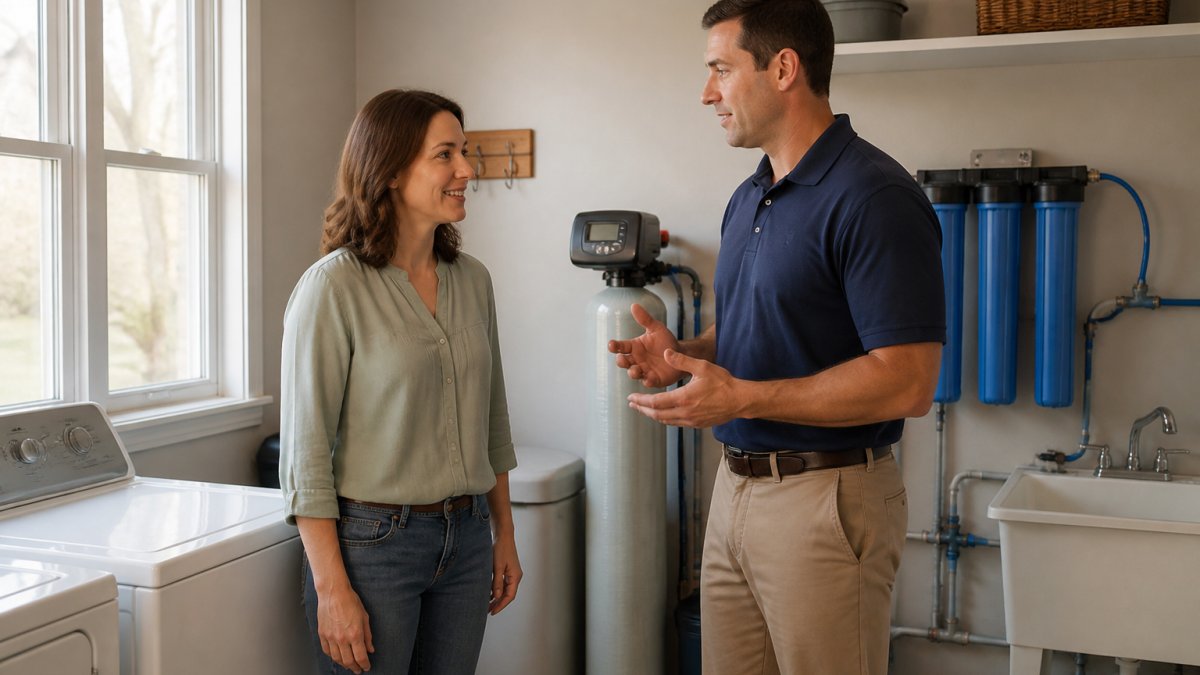
If you are unsure how to estimate your peak, a water test consultation can walk through your fixtures and plumbing layout and recommend a size that protects pressure instead of guessing at it.
Step 4: Decide Between a Whole-House Filter vs. Reverse Osmosis
The whole-house filter vs. reverse osmosis question comes down to scope. A whole-house system treats every tap for taste, odor, chlorine, and sediment. Reverse osmosis treats one tap and removes a much wider range of dissolved contaminants, producing high-quality drinking water.
Most city-water homes end up with both, and that pairing makes sense. The whole-house carbon filter protects plumbing, appliances, and skin. A point-of-use reverse osmosis system under the kitchen sink handles drinking and cooking water.
- Whole-house only: good taste everywhere, lower upfront scope
- RO only: excellent drinking water, no shower or laundry benefit
- Both: full-home taste protection plus refined drinking water
Step 5: Check Certification Claims and What the System Cannot Remove
Certification claims are only meaningful when they name a specific contaminant. A filter labeled "certified" tells you little. Look for a listing that names the standard and the exact contaminant it was tested against.
NSF/ANSI standards are the benchmark to check. Match the certified claim to the contaminant on your test report. If the box says it reduces lead, confirm the lead claim is certified, not implied.
What a whole-house filter cannot do matters just as much:
- It will not soften hard water; that needs a softener
- It will not kill bacteria or viruses
- It will not remove every dissolved mineral
- It will not fix a plumbing problem upstream
Step 6: Plan Whole-House Water Filter Maintenance Before You Buy
Whole-house water filter maintenance is the cost most buyers forget. Cartridges have a lifespan, and replacement schedule depends on water quality and household size. Sediment cartridges clog faster than carbon, so plan for both.
Before you buy, ask three questions:
- What is the replacement schedule?
- What do cartridges cost over a year?
- Is there a bypass valve for service?
A bypass valve lets you keep water running during a cartridge change. It is a small feature that saves real hassle. Factor replacement cartridges into your total cost of ownership, not just the install price.
| Decision | What to Check | Why It Matters |
|---|---|---|
| Water testing | Tap sample and municipal report | Reveals what to target |
| Filter media | Carbon, catalytic, sediment | Matches removal to contaminant |
| Sizing | Peak flow and pressure drop | Protects shower pressure |
| Scope | Whole-house vs. RO | Covers every tap or one |
| Certification | Named standard and contaminant | Proves the claim |
| Maintenance | Schedule and cartridge cost | Controls yearly cost |
Choosing a whole home water filter for city water comes down to testing first, then matching media, size, scope, and certification to what your water actually contains. We install whole-home carbon filtration and reverse osmosis systems, then handle maintenance and filter replacement so your system keeps performing. Book your free water test and consultation and get a plan built around your water.
Frequently Asked Questions
Do you need a whole home water filter if you have city water?
Not always, but many homeowners want one. Municipal systems disinfect water and meet provincial safety standards, yet chlorine or chloramine taste, odour, and sediment can still reach your taps. A whole home water filter is a choice about taste, odour, and specific contaminants rather than a fix for unsafe water. Test your water first, then decide whether a carbon or sediment system addresses what you actually notice.
What does a whole-house carbon water filter remove from city water?
Activated carbon targets chlorine, chloramine (with the right media), many taste and odour compounds, and some volatile organic compounds. It does not soften hard water or remove dissolved minerals, and it is not a disinfectant. Check the manufacturer's certified performance claims for the specific contaminants you care about, and confirm the media suits chloramine if your municipality uses it rather than chlorine.
Is a whole-house filter better than an under-sink reverse osmosis system?
They solve different problems. A whole-house filter treats water at every tap for taste, odour, and sediment, while reverse osmosis at the kitchen sink reduces dissolved contaminants for drinking and cooking. Many households run both: carbon filtration for the whole home and RO for drinking water. Your water test results and budget decide whether you need one, the other, or a combination.
How often should a whole-house water filter cartridge be replaced?
Replacement intervals depend on the media, your water quality, and how much water your household uses. Sediment cartridges typically need changing more often than large carbon tanks. Build a replacement schedule from the manufacturer's guidance and your water test results, and check pressure drop as a signal that a cartridge is loading up. Skipping changes can reduce flow and let contaminants pass.