 how-to
How Do You Test Water Hardness Levels at Home?
Last Updated: October 30, 2026
Quick Summary
To test water hardness levels at home, use a test strip or titration kit to measure dissolved calcium and magnesium, then compare the result to a hardness chart. Hardness is reported in mg/L, ppm, or grains per gallon, so convert units before comparing. For precise numbers, a laboratory analysis is the better choice.
- Test strips give a quick estimate by matching pad colour to a printed chart.
- One grain per gallon equals about 17.1 mg/L, so convert units before comparing results.
- Above 180 mg/L is very hard water, usually calling for treatment.
- TDS readings do not measure hardness, so use a strip, titration kit, or lab test.
- A laboratory analysis is worth it for softener sizing or private well water.
Table of Contents
- Why Water Hardness Levels Matter for Your Home
- Understanding Hardness Units: ppm, mg/L and Grains per Gallon
- Using Water Hardness Test Strips Step by Step
- Reading a Water Hardness ppm Chart
- Does TDS Measure Water Hardness?
- When a Water Hardness Test Laboratory Analysis Is Worth It
- Booking Your Free Water Test to Confirm Your Results
- Frequently Asked Questions
Hard water is one of the most common problems Ontario homeowners deal with, and it often shows up as crusty scale on faucets, dull laundry, and dry skin after a shower, especially once you start paying attention to water hardness levels in your home. Before you spend money on a softener or any other treatment, you need to know how hard your water actually is. Testing water hardness at home is quick, and it gives you a number to work from. Pure Life H2O helps homeowners across the Greater Toronto Area understand their water, and the first step is always the same: measure it. If you would rather not guess, you can GET YOUR FREE WATER TEST with the team and have the numbers confirmed on site.
This guide walks through the main home testing methods, explains the units you will see on test results, and shows you when a laboratory analysis is the better choice. Water hardness is caused mainly by dissolved calcium and magnesium. A test measures those minerals, and the result tells you how much scale and soap-scum problems you can expect.
Why Water Hardness Levels Matter for Your Home
Hardness matters because it affects far more than your taste buds. Minerals in hard water leave deposits wherever water is heated or left to dry. Over time, these deposits narrow pipes, coat water heaters, and reduce the efficiency of appliances.
Knowing your hardness level helps you decide whether a problem is worth fixing. A mildly hard supply may need only light maintenance, while very hard water usually calls for treatment.
- Fixtures: Scale builds up on showerheads, faucets, and tile grout.
- Appliances: Water heaters, dishwashers, and kettles lose efficiency as scale accumulates.
- Laundry: Minerals can dull fabrics and leave them stiff.
- Skin and hair: Many people notice dryness or dull hair after showering in hard water.
If you have seen these signs, a test is the logical next step. It turns a vague suspicion into a measurable result.
Understanding Hardness Units: ppm, mg/L and Grains per Gallon
Hardness test results come in several units, and this is where many homeowners get confused. The three you will see most often are parts per million (ppm), milligrams per litre (mg/L), and grains per gallon (gpg).
- ppm and mg/L: For drinking water, these two units are effectively the same. One part per million equals one milligram per litre. Most lab reports use mg/L.
- Grains per gallon (gpg): This is an older unit still common on softener packaging and US-made test kits. One grain per gallon equals about 17.1 mg/L.
Because test kits use different units, always check the scale before you read the result. If a kit reports in gpg and a softener manual uses mg/L, convert the number before you compare them.
Using Water Hardness Test Strips Step by Step
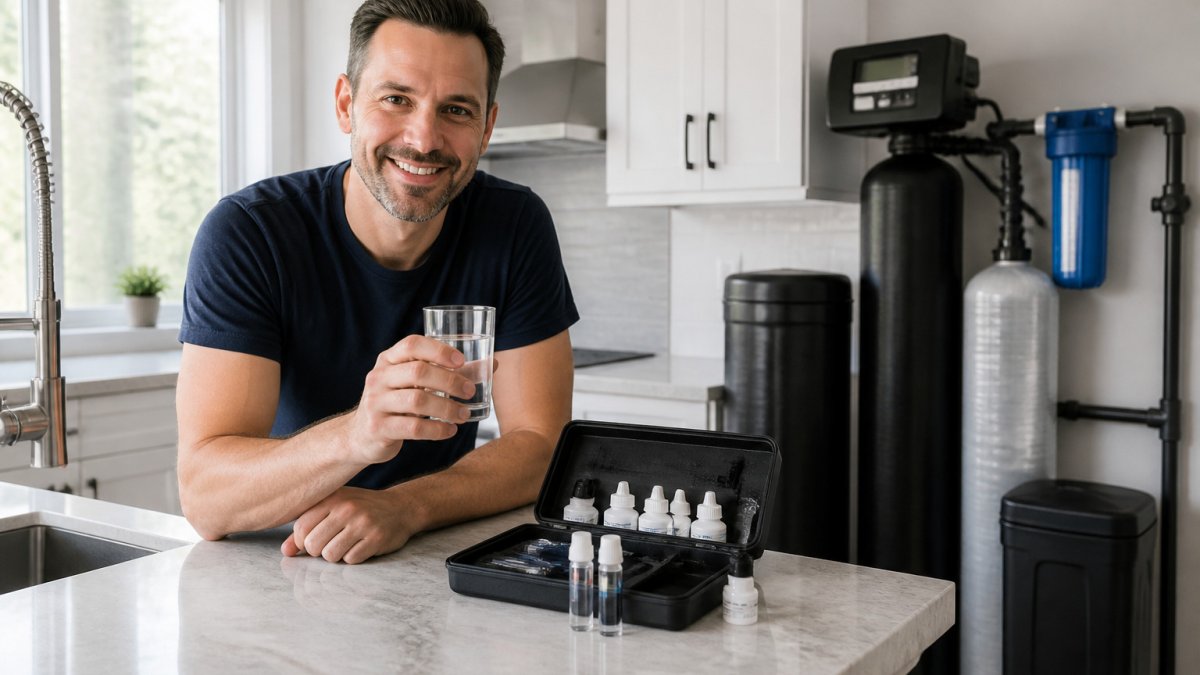
Test strips are the simplest home method. Each strip has pads that change colour when they contact minerals in water. You compare the colour to a printed chart.
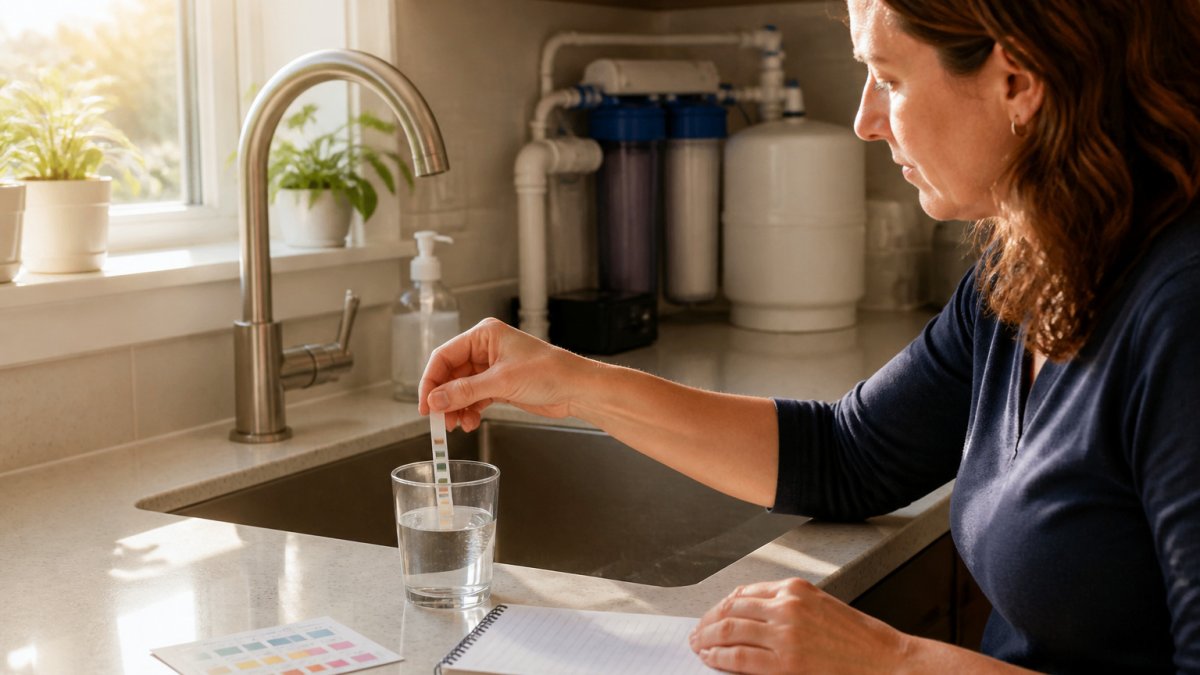
What you need:
- A water hardness test strip kit
- A clean, clear glass or cup
- Tap water at room temperature
- A timer or clock
Steps:
- Run the cold tap for about one minute to clear the line.
- Fill your clean glass with water from the kitchen tap.
- Dip the test pad into the water for one second, then remove it.
- Shake off the excess and wait the time listed on the package, usually about 60 seconds.
- Compare the colour of the pad to the chart in good daylight.
Watch out: Do not touch the test pad with your fingers. Oils on your skin can change the colour and give a false reading.
Strips are quick and useful for a rough check. They are less precise than a laboratory test, so treat the result as an estimate.
Reading a Water Hardness ppm Chart
Once you have a number, the next step is turning it into meaning. Hardness is grouped into ranges, and the ranges are the same whether your result is reported in mg/L, ppm, or grains per gallon, you just need to convert first.
| Hardness (mg/L as CaCO₃) | Grains per gallon (gpg) | Category | What homeowners usually notice |
|---|---|---|---|
| 0 to 60 | 0 to 3.5 | Soft | Little scale, easy lathering, soap rinses cleanly |
| 61 to 120 | 3.6 to 7.0 | Moderately hard | Light film on glassware, occasional scale on fixtures |
| 121 to 180 | 7.1 to 10.5 | Hard | Visible scale on faucets and showerheads, soap scum in tubs |
| Over 180 | Over 10.5 | Very hard | Heavy scale, stiff laundry, appliance strain, frequent softener regeneration |
Converting between units. If your strip reports in gpg and you want to compare against a lab report in mg/L, multiply the gpg figure by 17.1. A reading of 12 gpg is roughly 205 mg/L, which lands in the very hard band. Going the other way, divide mg/L by 17.1.
Reading a strip against the chart. Test strips rarely give an exact number. A strip that matches the 120 mg/L colour patch might actually represent anything from about 90 to 150 mg/L depending on the brand and lighting. Treat the strip result as a band, not a precise value.
What the bands mean in practice. Soft water needs no hardness treatment. Moderately hard water is often tolerable but may still leave light film on dishes and shower doors; some homeowners choose a softener anyway for laundry and appliance longevity. Hard water is where most people start noticing problems and where a softener usually pays for itself in reduced scale and soap use.
A note on municipal reports. Many municipalities publish water quality reports that include a hardness range for the local supply. These ranges are useful context, but they describe the system as a whole, not your specific tap. A home test or a professional in-home test tells you what is actually arriving at your fixtures, which is the number that matters for equipment sizing.
These bands are a useful guide, not a substitute for a precise measurement. If you are sizing equipment or comparing quotes, confirm the number with a titration kit or a laboratory analysis before you commit.
Does TDS Measure Water Hardness?
TDS stands for total dissolved solids. It measures all the dissolved substances in water, including minerals, salts, and metals. Many homeowners use a cheap TDS pen and assume it reveals hardness. It does not.
A high TDS reading can come from hardness, but it can also come from sodium, chloride, or other dissolved material. Two waters with the same TDS can have very different hardness levels. For hardness specifically, use a hardness test strip, a titration kit, or a laboratory analysis.
When a Water Hardness Test Laboratory Analysis Is Worth It
Home tests are fine for a quick check, but some situations call for a lab. A laboratory analysis gives you an exact hardness figure along with other water quality data, iron, manganese, sulphate, chloride, sodium, and, for private wells, bacteria, that a strip cannot detect.
What a lab actually measures. A hardness lab result is usually reported as mg/L of calcium carbonate (CaCO₃), which is a standardized way of expressing the combined calcium and magnesium content. The lab may also report calcium and magnesium separately, which is useful if you are choosing between a softener and a scale-control device.
Sampling technique matters. A lab result is only as good as the sample. Ensuring the integrity of your plumbing system also requires identifying lead pipes to prevent heavy metal leaching from skewing your water quality analysis.
Where results can vary. Hardness is not uniform through a home. Water from the cold kitchen tap may differ from water after a softener, and a well may show different readings before and after an iron filter. If you have treatment equipment, sample both the raw and treated sides so you can see what the equipment is actually removing.
When a lab is worth the cost:
- You are sizing a water softener and need an accurate number for regeneration settings
- You have a private well, where quality is not regulated the way municipal supply is
- Your home test results are inconsistent or unclear
- You notice rust colour, odour, or cloudiness along with scale
- You are buying a home and want a baseline before you move in
For private wells in particular, a lab test checks for problems a strip cannot detect. Private well water is worth testing regularly for bacteria and chemical contaminants, and a hardness result is most useful when it is read alongside those other parameters rather than in isolation.
Matching the method to the question. The soap-and-bottle test and test strips are screening tools, fast, cheap, and good for a rough band. A titration kit gives a more precise hardness number and is a reasonable middle ground for a confident homeowner.
If your results point to a treatment decision, a professional in-home test can confirm the numbers and connect them to the right equipment for your home.
Booking Your Free Water Test to Confirm Your Results
If your home test shows moderate to very hard water, or you want a precise answer before buying equipment, confirm the reading with a professional. Pure Life H2O offers a free in-home water test where a technician checks your water on site and explains what the numbers mean for your household.
When you already know your hardness level and want to see your options, you can explore water softeners designed for homes like yours. A reliable test is the foundation of a good decision, so start there and choose treatment based on real numbers.
Frequently Asked Questions
How do you test the hardness of water at home?
The simplest home method uses test strips or a liquid titration kit. Fill a clean, clear container with tap water, dip the strip or add the reagent drops as the instructions describe, then compare the colour change with the chart on the packaging. The result gives an estimate of calcium and magnesium content in ppm or grains per gallon. Run the test on cold water from a tap you use for drinking or laundry, and read it within the time the manufacturer specifies, since colours can keep changing after that.
How accurate are water hardness test strips?
Test strips are useful for a quick estimate, but they are less precise than a titration kit or a laboratory analysis. Their colour blocks usually step by a fixed amount, so a result can fall between two categories. Strips can also be affected by expired stock, humidity, or a dirty container. If your result sits close to a threshold that matters for a decision, such as whether to install a softener, confirm it with a more precise test or a professional water test.
Does TDS measure water hardness?
Not directly. A total dissolved solids (TDS) meter reports the combined concentration of all dissolved substances in water, including salts, minerals, and metals, in mg/L or ppm. Hardness comes mainly from calcium and magnesium. Water can have a high TDS and low hardness, or the reverse, so a TDS reading alone cannot tell you how hard your water is. Use a hardness test for that specific question.
Is 32 ppm hard or soft water?
A reading of 32 ppm as calcium carbonate is generally considered soft water. Hardness categories vary by source, but a common scale treats roughly 0 to 60 mg/L as soft, 61 to 120 mg/L as moderately hard, 121 to 180 mg/L as hard, and above 180 mg/L as very hard. Because your home's plumbing and any existing treatment can change the reading, retest at the tap you use most.