 How-to
How to Fix Limescale Buildup on Shower Heads
Last Updated: November 5, 2026
Quick Summary
To fix limescale buildup on a shower head, soak it in white vinegar, then scrub the nozzles and clear blocked holes. Soak time depends on how thick the scale is, from 30 minutes for a light film to overnight for heavy crust. Repeat the soak if needed, rather than extending it.
- Fill a plastic bag with white vinegar, secure it around the head, and soak for at least one hour.
- Soak light film for 30 to 60 minutes, moderate buildup for 2 to 4 hours, and heavy scale overnight.
- Use shorter soaks and a soft cloth on brushed nickel, oil-rubbed bronze, and matte black finishes.
- Never mix vinegar with bleach, because the combination releases harmful fumes.
- Repeat the vinegar treatment about once a month in harder water to prevent scale from hardening.
Table of Contents
- Why Shower Heads Develop Limescale
- What You Need Before You Start
- How to Clean a Shower Head with Vinegar
- How Long to Soak a Shower Head in Vinegar
- How to Remove Limescale from Shower Head Holes
- Cleaning Different Shower Head Finishes and Types
- Does a Water Softener Help Prevent Limescale on Shower Heads?
- Book a Water Test to Find Your Hardness Level
- Frequently Asked Questions
Why Shower Heads Develop Limescale
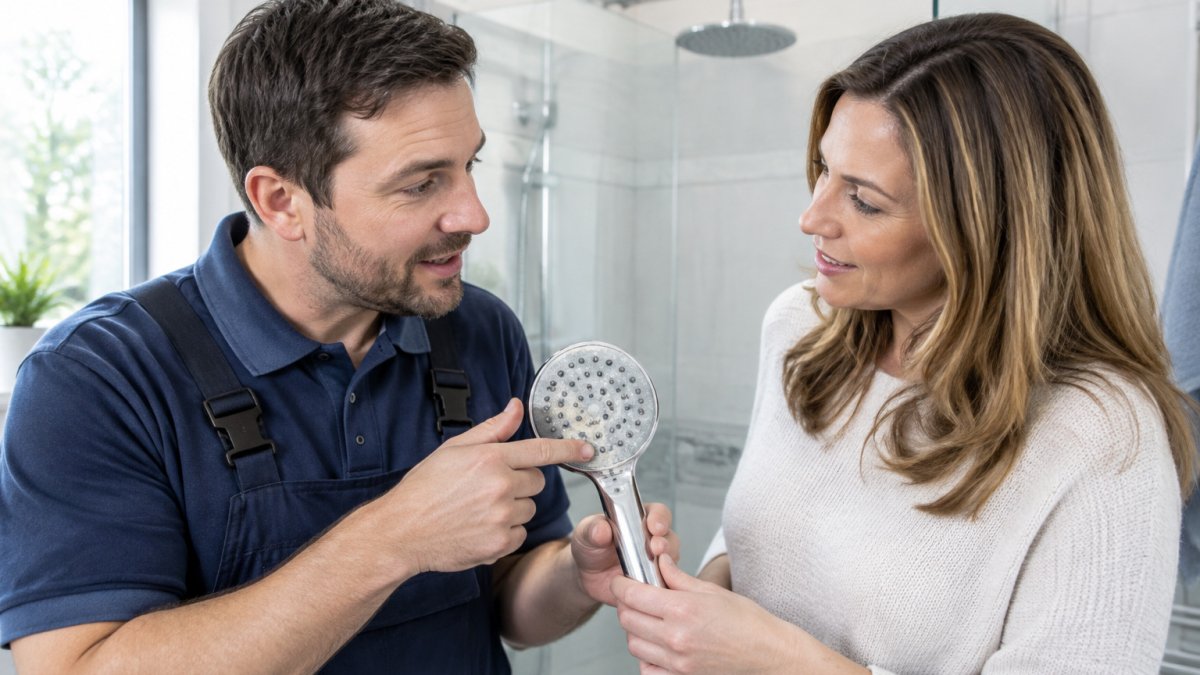
Limescale is the white, chalky crust that forms on shower heads when hard water dries, and it is the main source of limescale buildup on fixtures. To see how hard water affects skin and hair as well, read about hard water side effects on skin and hair. Hard water carries dissolved calcium and magnesium (Guidelines for Canadian Drinking Water Quality: Operational Parameters). As water evaporates from the nozzles, those minerals are left behind and build up inside the spray holes.
Over time, the buildup can narrow the holes and weaken the spray. Many homeowners first notice a patchy or sputtering flow, not the scale itself.
Watch for these signs:
- Spray holes that look white or crusted
- Uneven water pattern, with some jets blocked
- Lower water pressure at the shower
- A film on tiles and glass near the shower
What You Need Before You Start
Gather your supplies before you begin. Most of them are already in the house.
- White vinegar, enough to fill a small bag or bowl
- A plastic bag or cup that fits over the shower head
- A rubber band or zip tie to hold the bag in place
- A soft toothbrush for scrubbing the nozzles
- A pin or the tip of a paperclip to clear blocked holes
- A cloth and warm water for rinsing
Watch out: Never mix vinegar with bleach. The combination releases harmful fumes. Rinse all surfaces well before using any other cleaner.
How to Clean a Shower Head with Vinegar
Vinegar is a mild acid that dissolves calcium deposits. For most fixed shower heads, it is the simplest fix you can try at home.
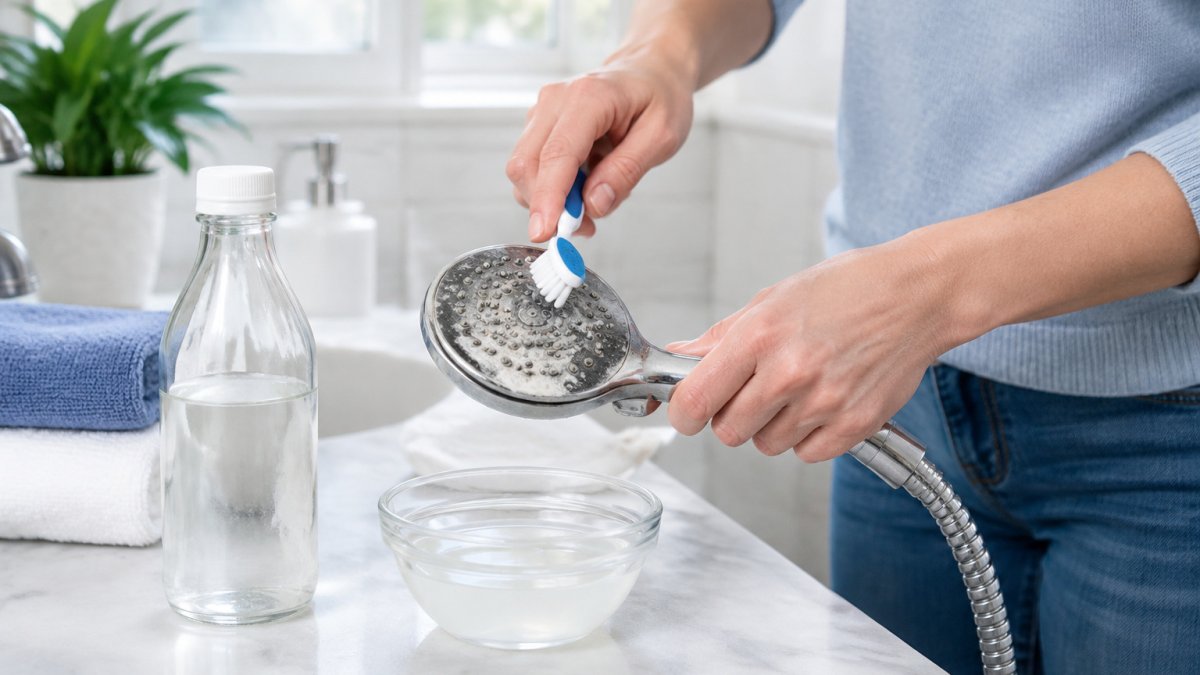
- Fill a plastic bag with enough white vinegar to cover the nozzles.
- Secure the bag around the shower head with a rubber band.
- Let it soak for at least one hour, or as directed in the section below.
- Remove the bag and run the water for a minute to flush loosened debris.
- Scrub the face of the head with a soft toothbrush.
- Rinse thoroughly with clean water.
If the shower head unscrews from the arm, you can soak it in a bowl of vinegar instead. This works well for heads that can't be bagged. Keep the arm clean with a cloth dipped in vinegar.
The article's vinegar method breaks down into a few clear steps, each with a soak time.
| Step | What to do | Time or frequency |
|---|---|---|
| Fill bag | Fill a plastic bag with white vinegar to cover the nozzles | Before soaking |
| Secure bag | Fasten the bag around the head with a rubber band | Before soaking |
| Soak | Let the head sit in vinegar | At least 1 hour |
| Flush | Remove the bag and run water to loosen debris | 1 minute |
| Scrub | Brush the face of the head with a soft toothbrush | As needed |
| Rinse | Rinse thoroughly with clean water | Final step |
How Long to Soak a Shower Head in Vinegar
Soak time should match both the thickness of the scale and the finish on your shower head. Vinegar is a mild acid, and while it dissolves calcium carbonate quickly, it can also dull or etch some coatings if left too long. Use the shortest soak that works, then repeat if needed rather than soaking longer in one go.
A practical starting guide:
- Light film (spray still mostly even): 30 to 60 minutes
- Moderate buildup (some jets blocked, white crust visible): 2 to 4 hours
- Heavy, crusty scale (weak or sputtering flow): overnight, up to about 8 to 12 hours
Finish matters as much as buildup. Chrome and polished brass generally tolerate a full overnight soak, but rinse and dry promptly afterward to protect the shine. Brushed nickel, oil-rubbed bronze, and matte black coatings are more sensitive; keep soaks to roughly one to two hours, check the surface at the one-hour mark, and stop as soon as the scale softens. For any specialty or unknown coating, test a small hidden area first and follow the manufacturer's care instructions.
Check progress hourly. If the nozzles look clean and water flows evenly, stop, there is no benefit to soaking longer. If scale remains after the first treatment, rinse, scrub with a soft toothbrush, and repeat the soak rather than extending it. Two shorter soaks are gentler on finishes than one very long one.
Watch out: Do not leave a bagged shower head soaking unattended for many hours on a coated finish, and never mix vinegar with bleach or other cleaners, the combination can release harmful fumes.
In harder water, plan on repeating the treatment about once a month to keep scale from hardening into thick crust. If you find yourself descaling every couple of weeks, that frequency is a sign to look at your water hardness rather than to soak longer. If frequent descaling does not restore the spray, mineral buildup may not be the only issue, and low water pressure can also affect how strongly the shower flows.
How to Remove Limescale from Shower Head Holes
Clogged holes are the most common cause of weak spray, but not every weak spray is scale. Before you spend time descaling, it helps to confirm the shower head is actually the problem, otherwise cleaning won't fix it.
Clear the holes step by step:
- After soaking, rinse the head under running water to carry away loosened scale.
- Gently scrub each nozzle with a soft toothbrush, working in small circles.
- Use a pin or the tip of a paperclip to clear stubborn holes. Work carefully so you don't enlarge or deform the openings.
- Run the water for about two minutes to flush debris out of the head and arm.
Avoid metal tools on coated or plated finishes, scratches can expose the base metal underneath and lead to corrosion.
Tell scale apart from other causes of low pressure:
- Scale in the head: spray is uneven or patchy, some jets are weak while others are strong, and the face looks white or crusted. Cleaning usually restores flow.
- Clogged inlet filter or screen: many handheld and fixed heads have a small mesh screen where the head meets the arm. If it's blocked with grit or debris, flow drops even after the nozzles are clean. Remove and rinse the screen if your model allows.
- Kinked or aging hose: a handheld hose that is twisted, cracked, or lined with buildup can restrict flow. Check for kinks and look at the hose interior.
- Problem elsewhere in the plumbing: if other fixtures also have low pressure, or the drop affects hot and cold equally, the cause is likely the supply, a valve, or a blocked cartridge rather than the shower head.
A quick test: unscrew the shower head and run the water through the bare arm into the tub or shower floor. Strong flow at the arm points to the head or its screen; weak flow there points to the plumbing or supply.
Watch out: Don't force a stuck shower head with excessive torque, you can crack the arm fitting or damage the finish. If it won't budge by hand, use a padded wrench and turn gently.
If you've cleaned the head, checked the screen, and confirmed good flow at the arm, but the spray is still weak, the head may have internal components or buildup that home descaling can't reach. At that point, replacement or a closer look at your water is the more practical next step.
Cleaning Different Shower Head Finishes and Types
Not every shower head reacts the same way to vinegar. Match your method to the finish and style.
- Chrome and polished brass: Vinegar works well. Rinse and dry promptly to protect the shine.
- Brushed nickel and oil-rubbed bronze: Use a shorter soak and a soft cloth. Harsh scrubbing can wear the coating.
- Matte black: Test a small area first. Some matte coatings can fade with acidic cleaners.
- Handheld heads: Remove the head from the hose if possible. Check the rubber nozzle face for buildup.
- Rain or large fixed heads: A bag may not fit well. A cloth soaked in vinegar and wrapped around the face can work.
Always check the manufacturer's care instructions if you are unsure. Finish-specific advice is worth a quick look before you start.
Does a Water Softener Help Prevent Limescale on Shower Heads?
A water softener reduces the calcium and magnesium that cause scale. Softened water leaves far less residue on shower heads, faucets, and tiles. Many homeowners find that scale returns much more slowly after installation.
A softener does not remove scale that has already formed. You still need to clean existing buildup with vinegar. Think of it as prevention, while cleaning is the cure.
If scale keeps coming back quickly, get your water tested. The results show how hard your water is and whether a softener is a good fit.
Book a Water Test to Find Your Hardness Level
Knowing your water hardness helps you choose the right fix. A simple test shows whether your buildup comes from hard water and how severe it is.
Pure Life H2O offers free water tests to help homeowners understand what is in their water. Recommendations are based on the results. Get your free water test to learn your hardness level and next steps.
Frequently Asked Questions
How do you remove limescale from a shower head?
Remove the shower head if you can, then soak it in a bag or bowl of warm white vinegar for several hours. Afterward, rinse thoroughly and use a soft toothbrush to loosen any remaining deposits from the spray holes. Wipe the surface with a soft cloth, reattach the head, and run the water for a minute to clear any loosened residue. Repeat the soak if the holes still look blocked. Avoid harsh abrasives, which can scratch chrome and brushed-nickel finishes.
How long should you soak a shower head in vinegar?
For moderate buildup, a soak of one to three hours in warm white vinegar is usually enough. For heavy, crusty deposits, leave the shower head overnight. Check the head partway through, and if the deposits are softening, you can gently scrub and continue soaking. Rinse well afterward so no vinegar smell or residue remains on the fixture.
Can you clean a shower head without removing it?
Yes. Fill a plastic bag with enough white vinegar to cover the shower head, then secure it around the head with a rubber band or tie so the spray holes are submerged. Leave it in place for one to two hours, then remove the bag, scrub the holes with a toothbrush, and run the water to flush out loosened deposits. This method avoids unscrewing fittings, which can be useful for shower heads that are hard to remove.
Does a water softener help prevent limescale on shower heads?
A water softener reduces the calcium and magnesium that cause hard-water scale, so it can slow new buildup on shower heads, faucets and fixtures. It does not remove scale that has already formed, so existing deposits still need to be cleaned. Pure Life H2O can test your water hardness and recommend a suitable softening system for your home. Get your free water test at purelifeh2o.ca/water-testing.
Still seeing limescale after cleaning? Hard water may be the root cause, and a professional assessment can save you time. Reach out to Water Softeners, Reverse Osmosis & Whole-Home Water Filtration Systems to discuss a softening solution that fits your home and water supply.