 How-to
How to Test Well Water Quality at Home and in the Lab
Last Updated: November 12, 2026
Quick Summary
Test your well water quality at least once a year for bacteria, nitrates, total dissolved solids and pH, using an accredited laboratory. Collect the sample from a tap before any treatment, using a sterile bottle, keep it cold, and deliver it within the time limit. Retest sooner after flooding, illness, or repairs.
- Test well water at least once a year for bacteria, nitrates, total dissolved solids and pH.
- Retest after cloudiness, odour change, illness, flooding, or pump and pipe repairs.
- Use a sterile lab bottle, sample before any filter, and keep it cold.
- Use accredited laboratory results for bacteria and health decisions; home strips are only screening tools.
- Any E. coli detection means the water is unsafe to drink until fixed and retested.
Table of Contents
- Why Testing Your Well Water Quality Matters
- How Often Should You Test Well Water?
- What to Test For: Bacteria, Chemicals and Physical Properties
- Step-by-Step Well Water Sample Collection
- DIY Test Kits Versus Accredited Laboratory Analysis
- How to Read and Interpret Your Well Water Test Results
- Booking Your Well Water Test With Pure Life H2O
- Frequently Asked Questions
Why Testing Your Well Water Quality Matters
If your home runs on a private well, the water coming out of your tap is your responsibility. No utility is testing it for you. A regular test tells you what is actually in your water, so you can judge your well water quality with facts rather than guessing based on how it looks or tastes.
Many dangerous contaminants have no smell, taste or colour. Research published by the National Center for Biotechnology Information notes that well users often rely on sensory cues to judge safety, even though many contaminants give no warning at all. National Center for Biotechnology Information study on communicating private well water test results
Testing gives you facts. It shows whether bacteria, nitrates, metals or minerals are present, and at what level. From there, you can decide what to do next, whether that is a simple disinfection step, a filter, or a treatment system.
How Often Should You Test Well Water?
At a minimum, test your well water once a year for bacteria, nitrates, total dissolved solids and pH. The U.S. Centers for Disease Control and Prevention recommends annual testing for these parameters as a baseline for private wells. CDC guidance on private well water testing
Test more often if you notice a change. Consider retesting when:
- Water becomes cloudy, discoloured or has a new odour
- Someone in the home gets sick with stomach symptoms
- Flooding or heavy rain happens near the well
- You repair or upgrade the pump, pipes or well casing
- You sell the home or buy a new one
Some contaminants, such as heavy metals, lead and copper, call for testing about every two years. NC Epidemiology private well testing schedule
What to Test For: Bacteria, Chemicals and Physical Properties
A full picture of your water has three parts. Each one answers a different question.
Bacteria
- Total coliform bacteria: a general indicator of whether surface water or contamination can reach the well
- E. coli: a sign of recent contamination from human or animal waste
Chemicals
- Nitrates: often from fertilizer or septic systems
- Heavy metals, lead and copper: from plumbing or the geology around the well
- Pesticides and other chemicals, depending on land use nearby
Physical properties
- pH: how acidic or alkaline the water is
- Total dissolved solids: the overall amount of dissolved minerals and salts
- Hardness: calcium and magnesium, which cause scale
- Iron, manganese and sulphur: common causes of staining and smell
- Sediment and turbidity: cloudiness or grit
A comprehensive annual checklist for well water usually covers bacteria, nitrate, pH, total dissolved solids, hardness, iron, manganese, sulphur and sediment. 2026 private well water testing checklist
Private Well Water Bacteria Testing Explained
Bacteria testing is the most important test for most wells. Bacteria can make people sick quickly, and they often have no visible sign in the water.
A standard lab test looks for total coliform and E. coli. If total coliform shows up, the well may be exposed to surface water or soil. If E. coli shows up, the water is unsafe to drink until you fix the problem and retest.
Use an accredited laboratory for bacteria testing. Home test strips can give a quick signal, but they do not replace lab results.
Step-by-Step Well Water Sample Collection
Follow these steps to collect a clean sample for a lab. Lab instructions vary slightly, so always check the sheet that comes with your sampling bottle.
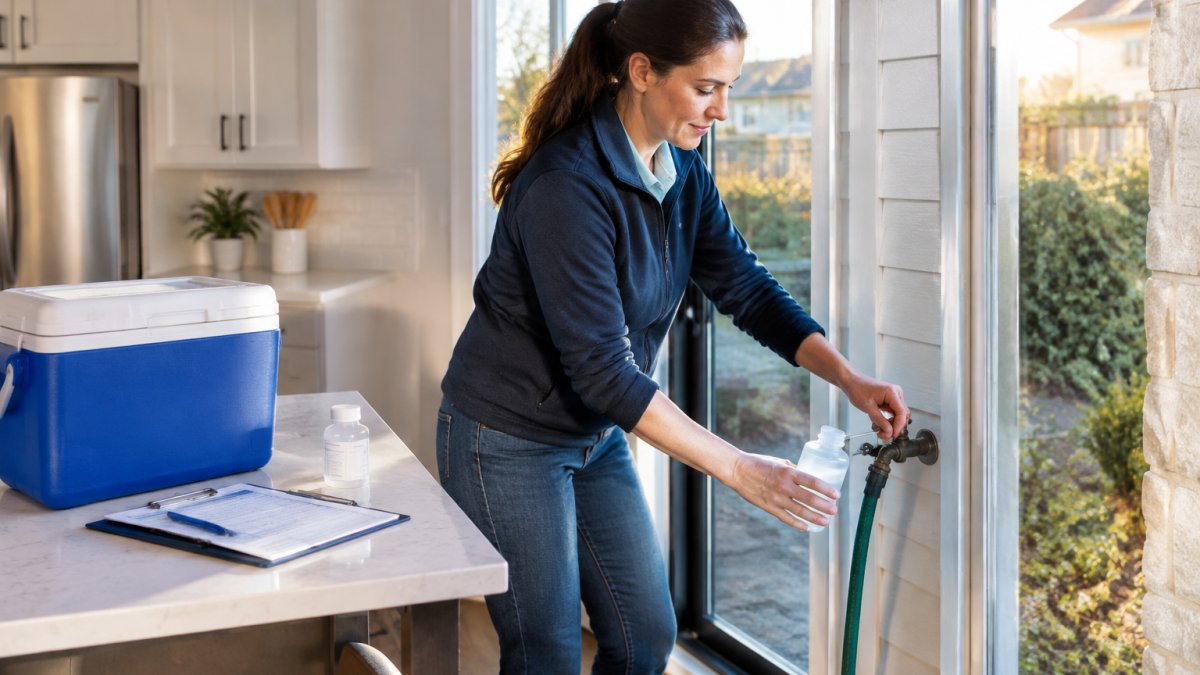
- Get the right bottle. Use a sterile bottle from the lab. Do not use an old drink bottle.
- Pick the tap. Use an outdoor hose bib or a kitchen tap that is close to the well and before any treatment or filter.
- Clean the tap. Remove any aerator or hose attachment. Wipe the spout with alcohol and let the water run for two to three minutes.
- Open the bottle carefully. Do not touch the inside of the cap or the bottle. Keep the cap facing down.
- Fill the bottle. Fill it to the line, leaving the space the lab asks for. Do not rinse the bottle first.
- Close and label. Seal the cap, then label the bottle with your name, the date and time, and the tap used.
- Keep it cold. Store the sample in a cooler with ice packs and keep it out of direct sunlight.
- Deliver it fast. Send the sample to the lab within the time limit listed on the form, usually within 24 to 30 hours.
Note the weather and any recent rain on your form. This helps the lab interpret the results.
DIY Test Kits Versus Accredited Laboratory Analysis
DIY test kits and accredited laboratory analysis answer different questions. Knowing which one you need, and when, saves you money and prevents false confidence.
What at-home kits can and cannot do
At-home strips and colorimetric kits are inexpensive and fast. They are useful for screening hardness, iron, manganese, pH, nitrate, and sometimes bacteria.
Their limits matter. Strip results are approximate, detection limits are often too high to compare against health-based guidelines, and bacteria strips are not a substitute for a laboratory culture.
How to choose a laboratory
Look for a lab that is accredited for drinking water testing.
Ask three questions before you send a sample:
- Which tests are included in each panel, and what are the detection limits?
- What is the holding time for each test, and how quickly must the sample arrive?
- What is the turnaround time, and how will results be reported?
A common pattern is that bacteria testing has the shortest holding time, so it often drives your delivery schedule. Chemical tests generally tolerate longer transport, but check the form that comes with your bottle.
How to choose a test panel
Start with the baseline panel most public health guidance recommends: total coliform, E. coli, nitrate, pH, total dissolved solids, hardness, iron, manganese, and sulphur. Then add tests based on your specific risks:
- Older plumbing or lead service lines: add lead and copper.
- Nearby agriculture or fertilizer use: add nitrate and pesticides.
- Septic system on the property: add nitrate, bacteria, and consider pharmaceuticals if you suspect septic influence.
- Mining, industry, or historical fill nearby: ask the lab about metals such as arsenic and uranium.
- Recent flooding or surface water intrusion: retest bacteria and nitrate promptly.
- New to the home or buying: order a comprehensive panel that covers both health-related and aesthetic parameters.
If you are unsure which panel fits your situation, a professional water test can help you match the panel to your well, plumbing, and land use before you commit to laboratory analysis. You can get your free water test from Pure Life H2O to help work out which panel suits your home.
Cost and turnaround trade-offs
Costs vary by lab and panel, so ask for a quote rather than assuming. Turnaround ranges from a few days for routine chemistry to longer for specialized analyses.
How to Read and Interpret Your Well Water Test Results
A lab report is easier to act on when you know what the numbers mean. Focus on units, limits, and trends before you decide on treatment.
Units and detection limits
Health-based limits versus aesthetic objectives
Reports often list a guideline or limit next to each result.
Detection is not the same as unsafe
Many contaminants are routinely detected at low levels that are well below health-based limits.
Bacteria results
Any E. coli result is serious. Treat the water as unsafe to drink until you fix the source and retest.
Nitrate and vulnerable groups
Nitrate is a health concern, especially for infants and pregnant people.
Metals and plumbing
Lead and copper often come from plumbing rather than the well itself.
Aesthetic parameters
Iron, manganese, sulphur, hardness, and total dissolved solids usually affect taste, colour, smell, and scale. Our iron and sulphur removal service for well water can help you match a solution to your results.
Look at trends, not just one number
Water chemistry changes over time. Compare new results with past tests to spot a rising nitrate level, a sudden bacteria hit, or a shift in hardness.
When to act
If any health-based limit is exceeded, follow the lab's advice and contact your public health unit.
Once your lab report arrives, these are the key things to check and what each one means for your next steps.
| Result type | What to check | What it means |
|---|---|---|
| E. coli | Present or absent | Any detection is serious; treat water as unsafe until fixed and retested |
| Total coliform | Present or absent | Well may be exposed to surface water or soil; investigate and retest |
| Health-based limit | Compared to report limit | Exceeding it needs prompt action and advice from your public health unit |
| Aesthetic objective | Iron, manganese, hardness, sulphur | Usually affects taste, colour, odour or staining, not immediate health |
| Detection limit | "Less than" result | Substance not found at a measurable level, not always zero |
| Nitrate | Compared to health limit | Elevated levels are a concern for infants and pregnant people |
| Trend over time | Compare with past tests | A rising value can signal a change even if one result looks acceptable |
Booking Your Well Water Test With Pure Life H2O
If you are ready to test, start with a professional well water test. A proper test gives you a clear baseline and shows which treatment, if any, makes sense for your home. You can book a free water test to review the key parameters for your home.
When you are ready to schedule, contact Pure Life H2O to arrange a time that works for you. We will walk you through the results and recommend next steps based on what your water actually contains.
Testing is the only reliable way to know what is in your well water. Book your free water test and consultation with Water Softeners, Reverse Osmosis & Whole-Home Water Filtration Systems, and get clear answers before you choose a treatment solution.
Frequently Asked Questions
How do you test the quality of well water?
Start with a certified laboratory test for bacteria, nitrates, and basic chemistry, since most contaminants cannot be seen, smelled, or tasted. Collect the sample in a bottle supplied by the lab, follow its instructions for timing and handling, and return it promptly. Your results will show which parameters are within acceptable limits and which need attention. Pure Life H2O can help you choose the right panel and interpret the report, and you can book a free water test to get started.
How often should private well water be tested?
Most guidance recommends testing private well water for bacteria and nitrates at least once a year. Total dissolved solids, pH, and hardness can be checked at the same time. Test more often if you notice a change in taste, odour, or colour, after flooding or heavy rain, or after repairs to the well or pump. Heavy metals and other chemical parameters are generally tested every few years or when a specific concern arises.
Can you test well water yourself, or does it need to go to a lab?
Home kits can give a quick indication of issues such as hardness, iron, or pH, but they are not reliable for detecting bacteria or many chemical contaminants. A certified laboratory analysis gives results you can act on and documents the test for real estate or insurance purposes. Use home kits for screening between lab tests, and send a sample to an accredited laboratory when you need definitive answers about safety.
What should you do if your well water test shows bacteria?
Do not drink the water untreated. Boil it for at least one minute, or use bottled water, until the problem is resolved. Check the well cap, casing, and surrounding area for cracks or sources of contamination, then have the well disinfected and retested after the work is complete. Repeat testing confirms whether the problem has cleared. If bacteria return, a treatment system such as UV disinfection may be needed, and a water treatment professional can assess the options.