 Ultimate guide
How to Choose the Right Water Softener Size for Your Home
Last Updated: November 21, 2026
Quick Summary
To choose the right water softener size, measure your water hardness in grains per gallon, estimate daily water use, and multiply them to find the hardness your home removes each day. Add a reserve allowance, then compare usable capacity at your intended salt dose rather than the box rating.
- Test your water hardness first, since sizing depends on it.
- Convert ppm to grains per gallon, using roughly 17 ppm per gpg.
- Multiply daily water use in gallons by hardness in gpg for daily load.
- Add about 20 percent reserve to cover guests, laundry spikes and outdoor use.
- Compare usable capacity at your salt dose, not the advertised grain rating.
Table of Contents
- Why Water Softener Size Matters More Than Brand
- Step 1: Test Your Water Hardness
- Step 2: Estimate Your Daily Water Use
- Step 3: Use a Water Softener Sizing Calculator
- Water Softener Size for a Family of Four
- Flow Rate, Pressure and Regeneration Frequency
- Book Your Free Water Test to Confirm Your Softener Size
- Frequently Asked Questions
Why Water Softener Size Matters More Than Brand
Choosing a water softener by brand alone is one of the most common and costly mistakes Ontario homeowners make. A unit that is too small regenerates too often, wastes salt and water, and lets hard water through before the next cycle.
Sizing guidance from Lowe's water softener sizing guide points to the same core inputs: how hard your water is, how much water your household uses each day, and how much hardness that water carries.
Step 1: Test Your Water Hardness
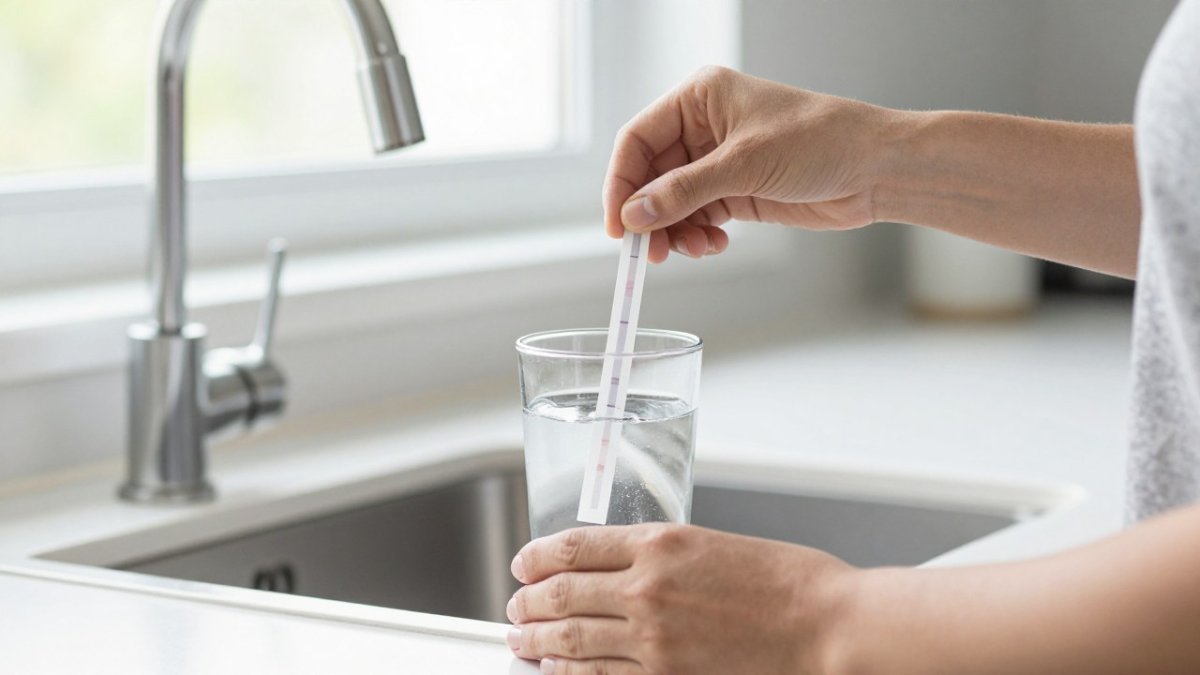
Before you can size anything, you need to know how hard your water is. Hardness comes mainly from dissolved calcium and magnesium (Guidelines for Canadian Drinking Water Quality: Operational Parameters). You can check it with a home test kit, but a lab or professional water test gives a more reliable reading, especially if you have a private well. You can learn how to measure hardness at home or book a professional test through our book a free water test.
Reading Results in Grains Per Gallon and PPM
Hardness is reported in two common units. Grains per gallon (gpg) is the unit softener sizing uses. Parts per million (ppm) is the more common unit on lab reports. As a rough conversion, 1 gpg equals about 17 ppm, so 10 gpg is about 170 ppm. Check which unit your test report uses before you run the calculation, because mixing them up is a frequent source of undersized systems.
Why Iron and Other Minerals Change the Calculation
Hardness is not the only input. Iron, and manganese in some cases, also consumes softener capacity. Iron is often added to the hardness figure when calculating capacity, and the exact method should be confirmed against your test results and the manufacturer's sizing guidance. Well owners should also learn to recognize signs of iron in well water, since iron staining and metallic taste often show up before a test is run.
Step 2: Estimate Your Daily Water Use
Next, estimate how much water your household uses per day. A common starting estimate is a set number of gallons per person per day, which you can refine by checking your own meter readings.
Keep in mind that this is an estimate. If you have a large tub, a high-flow shower, or a habit of running the washer daily, your number will be higher.
Step 3: Use a Water Softener Sizing Calculator
With hardness and daily use in hand, you can calculate the hardness you need to remove each day:
Daily hardness load = Daily water use (gallons) × Hardness (gpg)
The softener must remove that many grains each day. Multiply by the number of days you want between regenerations to find the raw capacity you need. Many homeowners aim for regeneration every three to seven days, which balances salt efficiency against the risk of running out of capacity during a busy stretch.
A Worked Example You Can Reproduce
Suppose your water tests at 12 gpg and your household uses 300 gallons per day.
- Daily hardness load: 300 × 12 = 3,600 grains per day
- Regeneration every 5 days: 3,600 × 5 = 18,000 grains of raw demand
- Add a reserve allowance of about 20 percent for guests, laundry spikes, and outdoor use: 18,000 × 1.2 = 21,600 grains
That 21,600-grain figure is your target usable capacity, not the number printed on the box. From there, compare units by their usable capacity at a realistic salt dose rather than their headline rating.
Usable Capacity Versus Advertised Grain Capacity
The grain capacity on a product label is not always the amount you can use. Rated capacity typically assumes a specific salt dose per regeneration, and lower salt doses generally mean lower usable capacity per cycle.
Watch out: sizing to the raw daily demand without a reserve allowance is the most common cause of a softener that runs hard between regenerations during high-use weeks.
Choosing Between Two Close Capacities
If your calculation lands between two standard sizes, the decision usually comes down to regeneration frequency and salt use. A slightly larger unit regenerates less often and holds more reserve, but it costs more upfront and can sit underused in a low-demand home. A slightly smaller unit regenerates more often, which uses more salt and water over time but keeps the unit cycling regularly.
You can also run this calculation with an online water softener sizing calculator once you have your numbers, but check that the tool asks for usable capacity and reserve rather than just raw grain demand.
The article walks through a worked sizing calculation, and the key inputs and results are easy to compare at a glance.
| Input or result | Example value | Note |
|---|---|---|
| Water hardness | 12 gpg | Measured by a home kit or lab test |
| Daily water use | 300 gallons | Estimated from household use or meter readings |
| Daily hardness load | 3,600 grains | Daily use multiplied by hardness |
| Raw demand at 5-day regeneration | 18,000 grains | Daily load multiplied by 5 days |
| Target with 20% reserve | 21,600 grains | Usable capacity, not the box rating |
Water Softener Size for a Family of Four
For a household of four, sizing guidance often lands in the 30,000 to 40,000 grain range, based on a rough household-size chart from Quality Water Treatment's sizing guide. Treat that as a starting point, not a final answer. A family of four in a home with 4 gpg water has very different needs from the same family on 20 gpg well water.
Flow Rate, Pressure and Regeneration Frequency
Capacity is only one part of sizing. A softener must also keep up with peak flow, the moments when a shower, the washer, and a dishwasher run at once, without dropping pressure. A unit that is undersized for peak flow, or plumbed through restrictive fittings, can cause a noticeable pressure drop at fixtures.
Checking Peak Flow Against Your Fixtures
A practical way to sanity-check flow is to add up the fixtures likely to run simultaneously. A standard shower, a clothes washer filling, and a kitchen tap can together draw a meaningful share of a home's peak demand, and homes with multiple bathrooms or body-spray showers push that higher. If your calculation suggests a small unit but your home has high-flow fixtures, ask your installer to confirm the unit's service flow rating and pressure drop at that flow before you commit.
Regeneration Frequency and Metered Control
Regeneration frequency matters because a unit that regenerates every day wastes more salt and water than one that regenerates every few days at the right size. Metered regeneration, which triggers cycles based on actual water use rather than a fixed calendar, can adapt to changing household demand. That adaptability is especially useful in homes with variable occupancy, such as a cottage or a home with frequent guests.
Special Household Conditions That Change the Math
A few conditions shift sizing beyond the basic calculation. Seasonal occupancy, such as a household that swells in summer, argues for a reserve allowance or a slightly larger unit. High-use appliances, such as a large tub or a frequently run washer, raise daily demand. Well-water conditions, including iron and manganese, consume capacity and may call for pretreatment before the softener.
When a Conventional Softener Is Not the Right Fit
Ion-exchange softeners remove hardness by exchanging calcium and magnesium for sodium, and they need regeneration with salt. Salt-free conditioners work differently and do not remove hardness minerals in the same way. If your water has high iron, sulphur, or other well-water issues, pretreatment or a different treatment train may be the better answer. A professional water analysis is the reliable way to tell which category your home falls into before you size anything.
Book Your Free Water Test to Confirm Your Softener Size
Getting the size right takes accurate inputs, and a professional test removes the guesswork. Book your free in-home water test and we will measure your hardness, review your household demand, and recommend a softener size that fits your home. Our team at Water Softeners, Reverse Osmosis & Whole-Home Water Filtration Systems can also talk through options for iron, well water and drinking water, so you get a system sized for how you actually live.
Frequently Asked Questions
How do I calculate what size water softener I need?
Start with three numbers: your water hardness in grains per gallon, your household's daily water use, and the number of people living in the home. Multiply daily use by hardness to get your daily hardness load in grains, then multiply that by the number of days you want between regenerations, usually about 7. Compare the result with the usable capacity of the softeners you are considering, and leave some margin for changing demand. A water softener sizing calculator can do this math, but the inputs need to come from a real water test and an honest estimate of how your household uses water.
How many grains should a water softener have for a family of four?
A common starting point for a family of four is a softener in the 30,000 to 40,000 grain range, though the right figure depends on your water hardness. Rough household-size guides are sometimes used as a starting point, but they are only approximate. A family of four in very hard water may need more capacity, while the same family with moderate hardness may be fine with less. Always confirm the number against your test results.
How does water hardness affect water softener size?
Hardness is the single biggest factor in sizing. Water with a higher concentration of calcium and magnesium removes more of the softener's capacity each day, so a home with very hard water needs a larger unit or more frequent regeneration than a home with soft-to-moderate water. Iron also consumes capacity and should be added to the hardness figure when sizing, using the method described in your sizing guide and confirmed by testing.
How often should a water softener regenerate?
Regeneration frequency depends on the softener's capacity, your water hardness and your daily water use. A correctly sized unit often regenerates every few days, and many modern units use metered regeneration to trigger the cycle based on actual water use rather than a fixed schedule. If your softener regenerates very often, it may be undersized; if it almost never regenerates, it may be oversized, which can reduce salt efficiency and allow water to sit in the tank. Your installer can review the cycle settings after testing.
Is it better to oversize or undersize a water softener?
Undersizing is the bigger risk. An undersized softener runs out of capacity between regenerations, which lets hard water reach your fixtures and appliances and shortens the life of the resin bed. A modestly oversized softener is usually acceptable, though a very large unit can use more salt and water than necessary because it regenerates less often and the resin can degrade over time. Aim for a unit that covers your daily load with reasonable margin rather than the largest one available.
What is the difference between water softener grain capacity and flow rate?
Grain capacity is how many grains of hardness the softener can remove before it needs to regenerate. Flow rate is how many gallons per minute the unit can deliver at acceptable pressure. A softener can have plenty of grain capacity but still struggle if your household runs several fixtures at once, because it cannot deliver enough water quickly. Sizing should check both figures, especially in homes with multiple bathrooms or high simultaneous demand.
Do I need a different water softener for well water?
Well water often needs more than a standard softener. Iron, sulphur and sediment can foul the resin and reduce capacity, so a well water home may need pre-treatment or a unit designed for iron removal. Well water hardness and iron content can also vary from season to season, which is one reason a current water test matters more for private wells than for municipal supplies. A water test is the right first step before choosing equipment.